
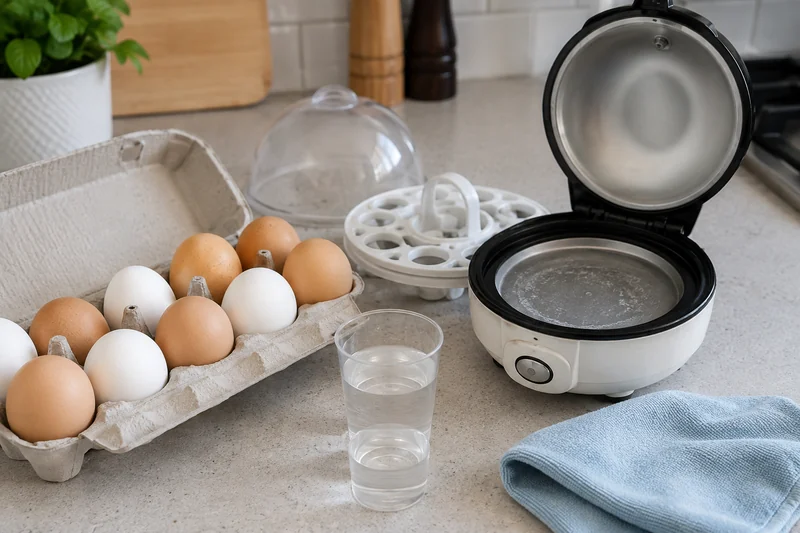
Reset the batch before replacing the cooker
An egg cooker can look automatic while still depending on several inputs. Egg size, refrigerator temperature, batch count, water volume, placement, lid position, mineral buildup, and an interrupted power cycle can all change the result.
The fastest diagnosis is not adding more water at random. It is holding every variable constant for one repeatable batch.
Start with the exact manual
Find the instructions for the model number on the appliance, not a visually similar cooker. Use its tray, water guidance, load limits, assembly sequence, alerts, cooling steps, and cleaning directions. Different cookers manage time and water differently; start with the exact product instructions, such as Cuisinart CEC-10 or Dash Deluxe, rather than another brand's water chart.
If a part is cracked, a cord or plug is damaged, the cooker smells hot, or it behaves outside the manual, unplug it and use the manufacturer's support path. Do not improvise an electrical repair.
Build one controlled batch
Choose eggs from the same carton and hold these inputs steady:
| Variable | Controlled repeat |
|---|---|
| Egg size | Use the same labeled size from one carton |
| Starting temperature | Use all refrigerator-cold or all room-temperature eggs, as the manual allows |
| Load | Repeat the same number of eggs in the same positions |
| Water | Use the supplied measure or exact manual quantity on a level surface |
| Assembly | Seat the tray and lid the same way |
| Power | Run one uninterrupted cycle from the same safe outlet |
| Finish | Use the same cooling step and timing before opening an egg |
Write down the outcome. Change only one variable on the next batch.
Water is a setting, not a guess
In many steam cookers, the amount of water helps determine the cycle. A heaped or underfilled measuring line can change the finish. So can reading the line at an angle or measuring on an uneven counter.
Use the exact model's guidance. Do not assume that more water always means a better result, and do not transfer another brand's chart to the appliance.
Batch size and placement can change the finish
A full tray and a two-egg breakfast do not create the same thermal load. Mixed egg sizes can also finish differently in one cycle. Seat each egg as directed, keep required vents clear, and avoid crowding beyond the published capacity.
If the model has stacked trays, follow the documented loading order. A tray that looks symmetrical may still have a required position.
Mineral residue deserves a clean test
White or brown spotting on the heating area can be mineral residue from water. It may affect heat transfer or simply make measurement and inspection harder. Clean and descale only with the method and frequency in the manual. Never immerse an electrical base unless the manufacturer explicitly says it is safe.
After cleaning, run the controlled batch again rather than changing water, load, and egg temperature at the same time.
Treat shell piercing as a model-specific choice
Some egg cookers include a piercing needle. Serious Eats recommends against using built-in piercers after observing leakage and cites a contamination concern. The safer editorial rule is simple: understand the exact instructions and tradeoff instead of treating the needle as a universal requirement. Handle any sharp point carefully and keep it covered in storage.
When the cooker may be the problem
After cleaning and two controlled repeats, contact the manufacturer if the same setup produces large unexplained swings, the alert or shutoff fails, the base does not heat normally, or the unit shows physical or electrical damage. Keep the model, date code, manual, batch notes, and a short video of the behavior if support requests it.
That record is more useful than “sometimes the eggs are wrong.” It also helps separate a setting issue from a product fault.
Bottom line
Make the inputs boring before blaming the appliance: same eggs, same starting temperature, same count, exact water, correct assembly, uninterrupted cycle, and a clean heating surface. Change one thing at a time.
If the routine itself is the problem, revisit whether an appliance is worth it with the weekly egg-job guide. If the job is clear but the format is wrong, compare the three research lanes.