
Buy for what happens after the car starts
An emergency kit and a parked-car maintenance setup solve different problems. If the vehicle needs occasional starting help away from home, portability matters. If it sits unused near a suitable outlet, a supported charging and maintenance routine is the more relevant feature to investigate.
NOCO states that its Boost jump starters cannot charge a car battery. Their USB device-charging features do not change that vehicle-battery limitation.
| Situation | Tool to investigate | What still needs checking |
|---|---|---|
| Starting assistance away from an outlet | Portable jump starter | Vehicle approval, battery system and engine coverage |
| Restore charge while parked with time available | Compatible battery charger | Chemistry, voltage, capacity and permitted charging method |
| Keep a supported battery charged during storage | Charger with a maintenance mode | Vehicle instructions, location and ongoing power access |
| Battery repeatedly goes flat | Battery and charging-system diagnosis | Cause of the fault before another accessory purchase |
Two products, two different jobs
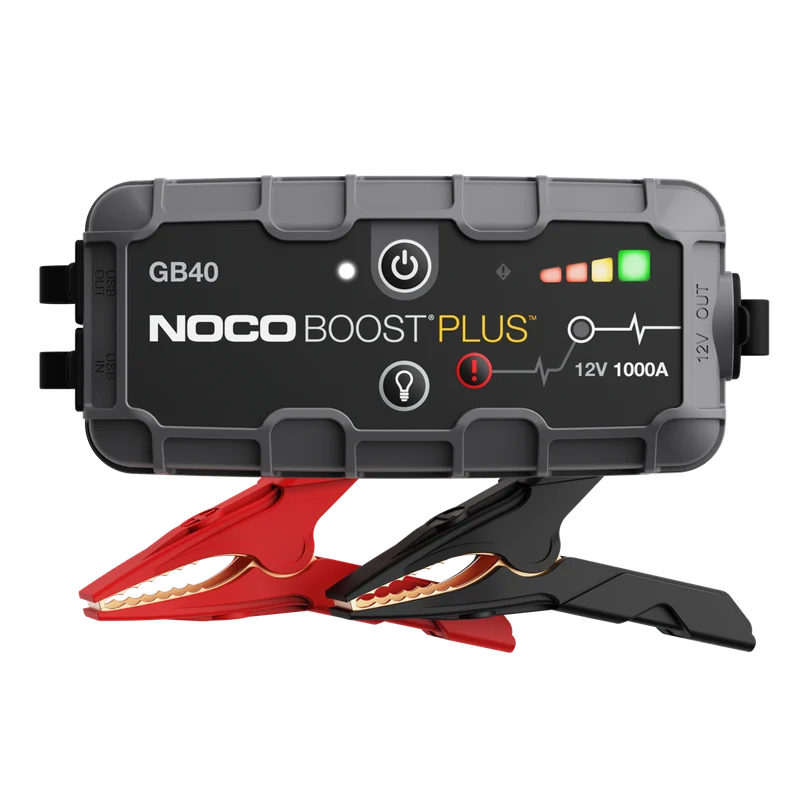
These are examples of the functions, not interchangeable products. The NOCO GB40 specifications is a portable starting pack. The GENIUS5 product page describes a plug-in charger and maintainer.
| Decision detail | NOCO GB40 | NOCO GENIUS5 |
|---|---|---|
| Primary job | Help start a compatible vehicle | Charge and maintain compatible batteries |
| Power for that job | Stored energy in its rechargeable pack | AC power while charging |
| Manufacturer output label | 1,000 A starting rating | 5 A charging current |
| Compatibility starting point | 12 V lead-acid vehicle batteries; stated engine limits apply | 6 V or 12 V supported lead-acid types; a separate supported 12 V lithium mode |
| Leave connected for storage maintenance? | Not a car-battery charger | Maintenance is a documented function; follow exact instructions |
The amp labels answer different questions. A 1,000 A starting rating is not 200 times the charging ability of a 5 A charger. Do not put them on a shared “power winner” chart. Select the function first and compare specifications within that function.
Check the battery, not just the vehicle badge
Read the vehicle and accessory manuals before connecting anything. Match voltage, chemistry, capacity where specified, connection points and the approved method. A product sold for cars is not automatically suitable for every battery in every car.
NOCO's GENIUS5 support guide specifies a battery management system for its supported lithium mode, and describes maintenance after charging. It also warns that Force Mode disables safety features. Treat override modes as specialized instructions, not a selling point or a routine fix for an unidentified battery.
NHTSA distinguishes an electric vehicle's high-voltage traction battery from its separate low-voltage system. A high-voltage EV battery cannot be jump-started. Follow the exact vehicle manual for any permitted low-voltage assistance.
What paying more needs to buy
Within jump starters, compare documented vehicle coverage, clamp reach and the pack's recharge and storage requirements. Within chargers, compare supported battery capacity, chemistry and the charging time your schedule allows. More charging current is useful only when both the battery and vehicle permit it; do not select it from engine displacement.
For storage, include a suitable location and power arrangement in the plan. For an emergency pack, include a routine for checking and recharging the pack itself. A tool that cannot be kept ready is a poor match for the job, regardless of its feature list.
If emergency starting is the need, the portable jump-starter comparison covers the existing shortlist. If a camera will run while the vehicle is off, also check the dash-cam parking-power guide: a jump starter is not a substitute for the camera's supported power system and cutoff plan.