
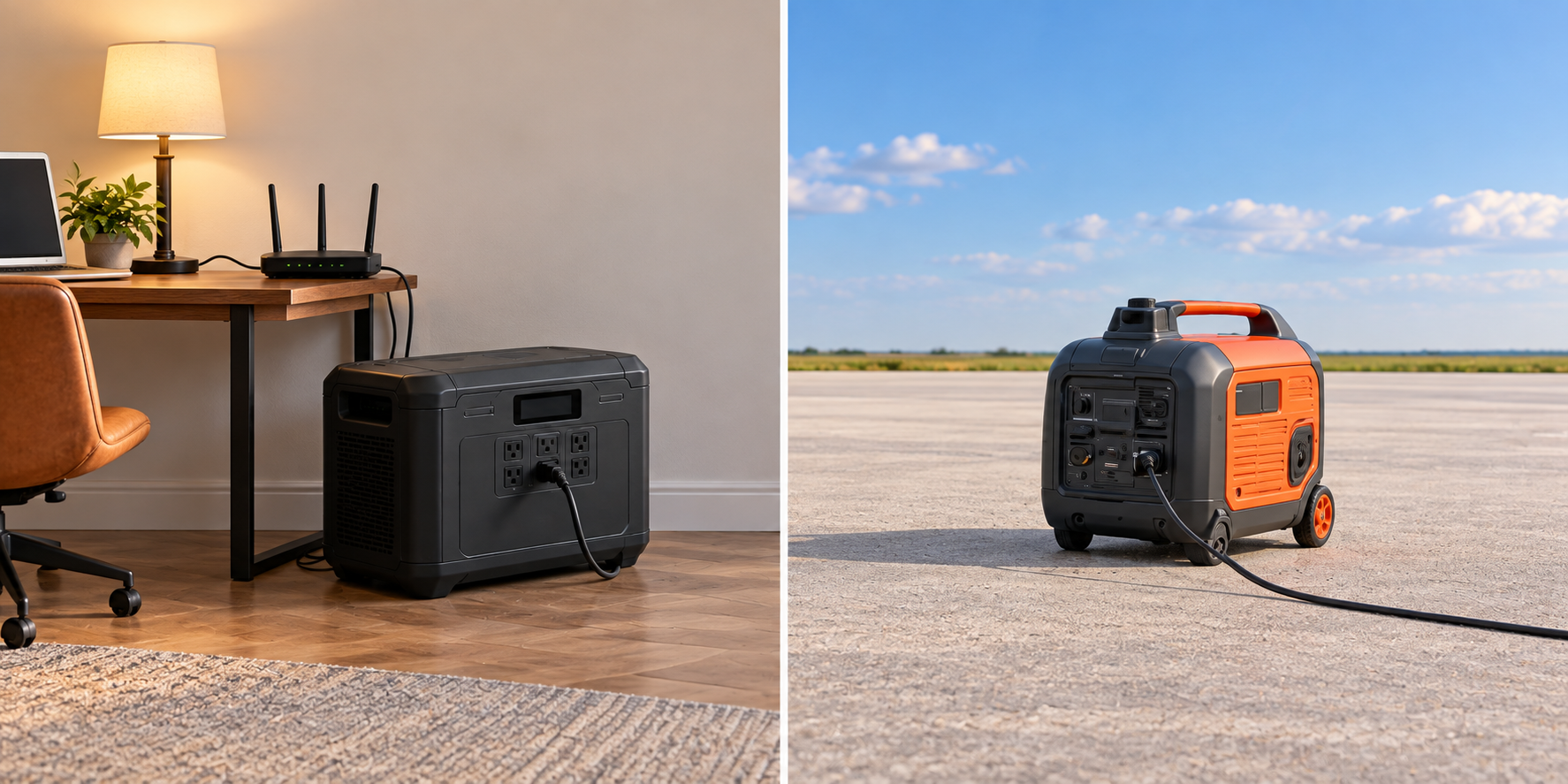
Size the outage job before choosing the machine
A portable power station stores a finite amount of electrical energy in a battery. An inverter generator converts fuel into electricity while it runs. That makes the first better suited to a bounded, quiet indoor load and the second potentially useful for longer operation when safe outdoor placement, fuel and maintenance are realistic.
| Outage job | Useful starting path | Disqualifying check |
|---|---|---|
| Router, laptop and a few small essentials for a defined period | Portable power station | Stored energy and output do not cover the measured load and time |
| Longer, refuelable supply for supported appliances | Inverter generator | No safe outdoor position at least 20 feet from the home |
| Apartment, attached building or site without controlled outdoor space | Portable power station or a smaller no-buy plan | Never operate a fuel-burning generator indoors, in a garage or too close to the building |
| Desktop shutdown protection | UPS first | Transfer behavior and automatic shutdown may matter more than total energy |
| Selected household circuits | Qualified transfer-equipment plan | Never improvise a connection or backfeed household wiring |
Output watts and stored energy answer different questions
EcoFlow lists the US DELTA 3 Plus with 1,024 Wh of battery energy and 1,800 W AC output, with a 3,600 W surge label. Honda lists the EU2200i at 2,200 W maximum and 1,800 W rated output. The shared 1,800 W figure does not make their runtimes interchangeable.
The battery starts with finite stored energy and loses some energy through conversion and operating overhead. The generator's runtime depends on fuel, load and conditions; Honda lists about 3.2 hours at rated load and up to 8.1 hours at one-quarter load on its tank. Those are manufacturer figures under different conditions, not a head-to-head Digital Derek test.
Measure or conservatively estimate the running watts for the essential equipment. Account for starting demand where the equipment maker requires it. Then compare the battery's usable runtime information or the generator's load-specific fuel use on a common load basis. Do not divide a nameplate maximum by another maximum and call the result runtime.
Safe placement can rule out the generator
The US Consumer Product Safety Commission says to operate a portable generator outside only, at least 20 feet from the house, with exhaust directed away. It also calls for working carbon-monoxide alarms on every level and outside sleeping areas. A garage, porch or open window is not a substitute for that separation.
If the property cannot provide the required placement and weather-safe cord route, the generator is not an acceptable fallback. Reduce the load, use an appropriately specified battery solution or make another outage plan. Never run a fuel-burning generator in an apartment or attached indoor space.
Ownership differs after the outage
EcoFlow lists the DELTA 3 Plus at 27.6 pounds and a five-year warranty. The battery still needs a charging and storage routine, and its actual delivered runtime depends on load, age and conditions. Solar input can extend some plans, but panel rating and sunlight are not guaranteed energy.
Honda lists the EU2200i at just over 47 pounds and documents fuel shutoff, oil alerts and maintenance needs. Fuel storage rules, periodic operation, oil changes and stale-fuel prevention become part of ownership. The generator also creates sound and exhaust while operating.
A combined plan can use a battery for quiet essential loads and a generator outdoors to recharge or serve other supported loads, but that is a more complex system. Confirm every charging input, cord, weather and operating instruction. Do not connect either source to household wiring without approved transfer equipment and qualified installation.
Use as you go
Your working checklist
0 complete
Build a load-and-time worksheet
Pick the constraint you can safely own
Choose a portable power station for a defined load and time when quiet indoor use and simple startup are the priorities. Consider an inverter generator when longer refuelable operation is necessary and the property supports safe outdoor use, fuel storage and maintenance.
For a desktop or network that needs short automatic battery support, compare a UPS with a portable power station first. The larger machine is not automatically the better answer; choose a setup that covers the essential load, duration and placement you can actually maintain.