
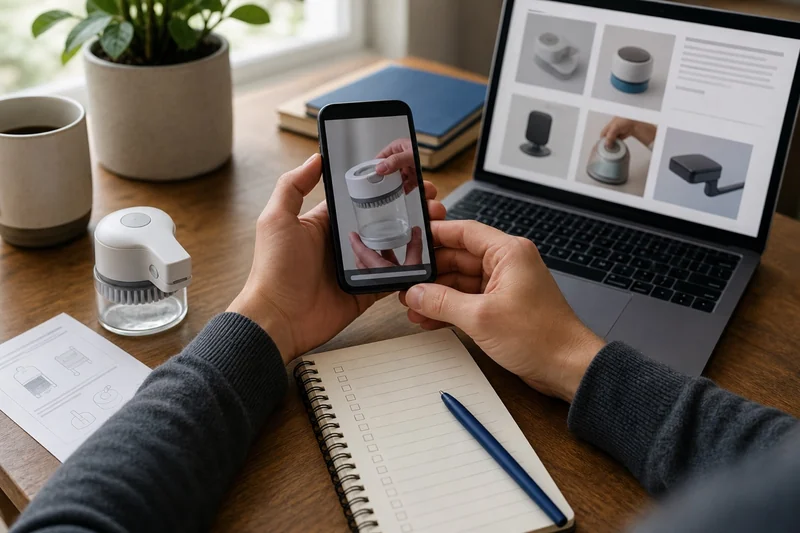
Find out whether a viral product will help with a job you actually have. Write down the result shown in the demo, compare it with what you already use, and check the exact model, seller, and supporting evidence. The five-minute checklist below gives you a practical way to decide whether to try it, keep your current solution, or check one remaining detail.
Turn the demo into a testable sentence
Replace “this works” with a sentence that includes the job, condition, and result. For example: “This tool removes dry crumbs from this fabric in one pass without visible damage.” Now list what the clip did not show: preparation, repeated takes, time, force, cleanup, failure cases, edits, or a comparison against something already owned.
Viral products earn a fair test only when you can name the job, the conditions, and the result. If the claim cannot be stated clearly, the video has not given you enough information to buy.
Use as you go
Your working checklist
0 complete
The five-minute viral-product check
Check the relationship before weighting the recommendation
Use a disclosure to understand the creator’s relationship with the brand, then assess the demonstration itself. When that relationship is unstated, leave it unknown rather than assuming the creator was paid.
The FTC Endorsement Guides explain that an unexpected material connection that could affect how people evaluate an endorsement should be disclosed clearly and conspicuously. Look near the recommendation itself—not only at a profile page or after a long caption.
Do not use follower count, views, likes, or polished production as substitutes for a method. Those signals describe attention, not product performance.
Trace the evidence instead of counting repeats
Five accounts can repeat one manufacturer's claim without creating five independent confirmations. Look for the first source, the exact model, the test conditions, and whether the reviewer shows failures as well as successes.
For customer reviews, use the separate guide to check online-review warning signs without guessing. The FTC's consumer advice recommends using a variety of sources, checking recency and reviewer history, and watching for bursts of reviews. Those are reasons to ask questions—not a reliable way to label an individual review fake.
Check whether the product can be identified and supported
Before performance, verify basics:
- an exact maker, model, and seller;
- instructions and meaningful warnings;
- a reachable support or warranty path;
- a return window that can accommodate a fair test;
- replacement parts or consumables when the product depends on them.
Search the CPSC recall and product-safety-warning database using the maker and model. Follow any matching warning before using or buying the product. If no warning appears, still follow the product’s instructions and the safety checks relevant to its use.
Health, beauty, supplement, and disease-treatment claims require a stricter stop. The FDA's health-fraud guidance warns about products promoted to prevent, treat, or cure conditions without being proven safe and effective for those uses. Do not turn a social-media checklist into medical advice; use the relevant regulator and a qualified health professional.
Define the cheapest fair test
Start with the outcome, not the product. If an owned tool or no-buy method solves the same job, use it as the baseline. If the viral product still seems useful, predefine:
- the exact surface, object, or situation;
- the starting condition;
- the time, passes, force, or setup allowed;
- the observable result;
- what counts as damage, failure, or unacceptable cleanup.
Record the control and the product under the same conditions. A satisfying close-up is not enough if the product takes longer, creates a second mess, damages the surface, or solves a problem you do not actually have.
Three outcomes are enough
Use skip, test, or hold:
- Skip when the problem is already solved, the claim cannot be defined, the seller or exact model is unclear, or a safety warning changes the risk.
- Test when the job matters, the exact product is identifiable, the claim is bounded, and the return and safety conditions permit a fair comparison.
- Hold when evidence is missing or conflicting. Unknown is a valid decision state.
What this checklist cannot prove
- It cannot determine whether a specific creator or reviewer is honest.
- It cannot prove safety, quality, or performance from public information alone.
- It does not replace regulator guidance for health, electrical, children's, automotive, or other higher-risk products.
Make the product earn the test
Do not ask whether the clip is convincing. Ask whether the exact claim survives attribution, safety, seller, baseline, and test-design checks. If it does, the product has earned a controlled test—not a verdict.
That leaves you with a practical next step: skip the weak pitch, hold when a key fact is missing, or test the strongest claim under conditions you control.
See how Digital Derek evaluates evidence before treating any shortlist as a winner.