
The short answer
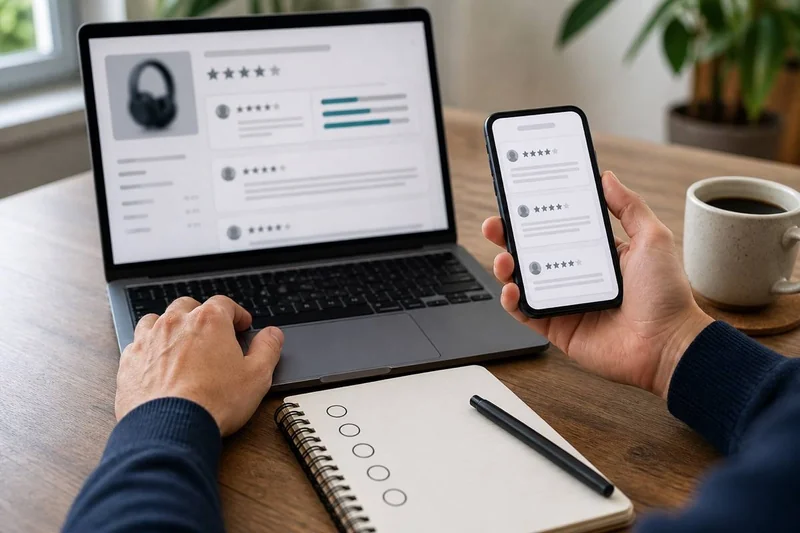
Use reviews to learn how a product fits real routines. Start with recent accounts of the exact model, then look for details about use, incentives and the reviewer's situation. The star average is a useful starting point; the experiences behind it help you decide.
The goal is not to announce that a review is fake. It is to decide whether the available evidence is strong enough to influence your next step.
Use the five-question evidence check
1. Who controls the source?
Is the review on a retailer, manufacturer, independent publication, creator channel, or company-controlled comparison site? The FTC recommends considering the source and using a variety of sources, including trustworthy independent expert reviews.
2. How recent is the evidence?
Check whether the review describes the current product and version. The FTC also says a sudden burst of reviews can sometimes warrant additional checking. Read the reviews’ specific experiences and model details alongside their dates before judging their credibility.
3. Is reviewer history visible?
When the platform permits it, examine whether the account has other relevant reviews and whether the experience described matches the exact product. An account with one review gives you less history to assess. Look for concrete product details and compare the experience with other independent reviews.
4. Is an incentive or relationship disclosed?
Look for labels describing a free product, sponsorship, employment, affiliate relationship, or other material connection. Missing information is an unknown; do not invent a relationship.
The FTC's current Reviews and Testimonials Rule guidance also distinguishes consumer reviews from promotional testimonials and warns about misrepresented use or experience.
5. Do other evidence families agree?
Compare the exact manufacturer/model details, official instructions, professional testing methods, independently disclosed limitations, and any later hands-on evidence. The FTC's online-shopping guidance says not to rely on star ratings alone and recommends reviewing multiple sources.
Give each source a useful role
Sort what you find into five practical groups:
- official claim: what the maker or platform states;
- professional test: a disclosed method and observed result;
- disclosed incentive: experience with a visible material connection;
- customer report: a self-reported experience that may be useful but is not independently verified;
- unknown: missing source, method, relationship, version, or context.
These groups help you compare unlike sources without turning uncertainty into an accusation.
What not to do
Do not copy customer reviews into a new score, run private or restricted review data through an unapproved scraper, accuse a named person or seller, or treat a writing style as proof of AI generation or fraud.
The FTC explicitly warns that it can be nearly impossible to distinguish real and fake reviews just by looking. A checklist should produce `stronger`, `weaker`, or `unknown` evidence—not a fake-review conviction.
Bottom line
Use more than the stars. Ask who controls the source, how current it is, what is known about the reviewer and incentives, and whether independent evidence agrees. Give the strongest weight to current, exact-model evidence with a clear method, then use the remaining reviews to reveal recurring strengths and tradeoffs.
See how Digital Derek separates research from a tested verdict. For a broader buying decision, use the viral-product claim check to define the promise, verify the seller and safety signals, and decide whether the product has earned a controlled test.