
Choose the attachment before the organizer
A shower caddy can have the right number of shelves and still be wrong for the shower. Suction needs a compatible surface. A hanging caddy needs a usable showerhead path. A tension pole needs the right vertical span and two stable contact points. A freestanding unit needs floor area that does not block feet, doors, drains, or cleaning.
The cheapest mistake to prevent is buying by basket capacity before mapping the mount. Start with the surface and geometry, then record the bottle load and daily reach.
Make this five-part shower map
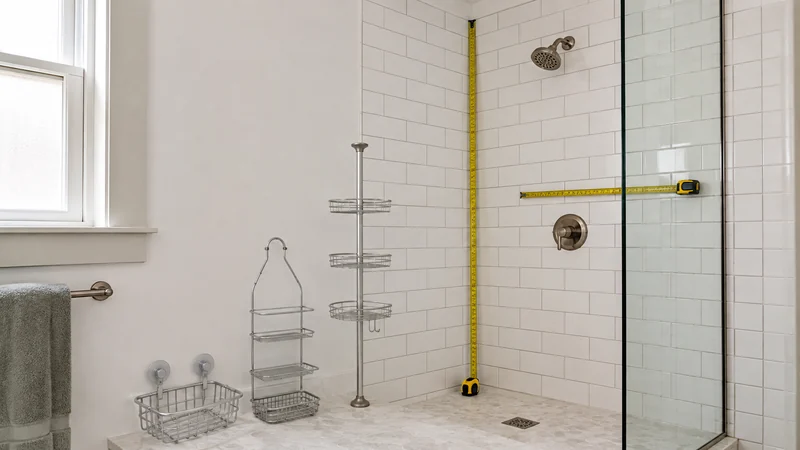
Dry the area, use a steel tape, and sketch the storage zone from the normal standing position. Keep raw dimensions separate from any product's fit range.
| What to record | Where to check | What it can reject |
|---|---|---|
| Surface | Tile face, grout, glass, fiberglass, stone, or painted wall | Suction or adhesive formats that exclude that finish |
| Mounting geometry | Showerhead collar and pipe, corner angle, ceiling and floor contact points | A hook, stabilizer, or pole that has nowhere reliable to sit |
| Clear dimensions | Width, depth, height, and floor-to-ceiling span at the exact mounting line | A basket that blocks controls or a pole outside its adjustment range |
| Bottle load | Tallest bottle, widest container, pump clearance, and total filled weight | Shelves with too little spacing or a mount being asked to carry the wrong job |
| Access and water path | Reach, spray, door swing, drain path, and cleaning route | Storage that traps water, blocks movement, or is hard to remove and clean |
Do not round a ceiling span to “about eight feet.” The tension product's published range must contain the actual contact-to-contact measurement at the chosen corner.
Suction: the surface is part of the mount
Suction can create a compact, tool-free storage zone without using the showerhead or floor. It is also surface-dependent. OXO's current StrongHold corner-basket instructions say to use the suction cups on smooth, glazed surfaces and position the cups to avoid grout lines.
That rules out a casual “it looks flat enough” decision. Textured tile, porous stone, grout crossings, residue, and a curved or uneven corner can interrupt the seal. Record enough clean tile face for every cup—not just enough wall area for the basket.
Use suction for a modest load whose location can be checked. It is not the default answer for a full household bottle collection on an unknown surface.
Showerhead-hung: map the collar, pipe, and stabilizers
A hanging caddy moves storage off the floor and can carry more than a small corner basket. The hidden constraints are above and behind it. Check whether the hook can seat around the showerhead pipe, whether the caddy clears the collar and controls, and whether its lower stabilizers land on usable wall surface instead of grout.
TechGearLab's shower-caddy test treated installation and stability as separate criteria and noted that suction stabilizers still depend on their wall alignment. Check that alignment on the caddy and wall you plan to use.
Hold a cardboard outline at the proposed height. Turn the controls, angle the showerhead, reach for a bottle, and confirm that the lowest shelf does not interfere with the hose, valve, or tub edge.
Tension pole: earn the premium lane with a different job
A floor-to-ceiling tension system is not simply a more expensive hanging caddy. It creates an independent vertical storage path with adjustable shelves. That can make sense when a household has tall bottles, multiple users, no compatible suction surface, and a clear corner with flat contact points.
The current simplehuman 8-foot tension caddy uses a spring-loaded pole, adjustable shelves, and a published 5-to-8-foot range. Its manufacturer describes stainless steel and anodized aluminum construction and a five-year warranty. Match the height range and contact surfaces to your shower, then follow the installation and care instructions.
Before choosing this lane, measure the exact vertical line, inspect the floor and ceiling at both contacts, and leave room to assemble and remove the pole. Higher price does not rescue an out-of-range ceiling or an unstable contact point.
Freestanding and over-door formats solve different constraints
A freestanding corner shelf avoids wall and ceiling attachment, but it consumes floor space and must remain stable on the actual shower pan. An over-door caddy needs a compatible enclosure and must not prevent the door from closing or create a sharp contact point.
These can be valid alternatives when the three primary mounts fail. They are not interchangeable with a compact wall basket, and they are not included in the exact-product shortlist until current exact options earn their own evidence lane.
Run a no-purchase mock-up
Cut a cardboard outline for the basket or shelf and tape it temporarily outside the wet area. Mark the planned mounting points. Place the real bottles on a dry counter in the same footprint and compare their heights.
Then ask:
- Can each mount land on the surface it requires?
- Can the tallest pump operate without hitting the shelf above?
- Can every user reach the daily items without moving another bottle?
- Can water drain and the wall or floor be cleaned?
- Can the showerhead, controls, door, and drain still do their jobs?
The mock-up helps you choose a format with room for your bottles and a workable reach. Use the maker's limits for load, installation and care.
Load gradually after installation
Follow the exact manufacturer's installation sequence. Start empty, then add one light item at a time while watching the mount, shelf angle, pole position, and wall contact. Stop if a cup lifts, a hook shifts, the pole bows or moves, or the unit interferes with normal shower operation.
Recheck after the first wet cycle and during cleaning. A caddy that stayed put while dry has not yet answered the steam, soap-film, repeated-use, and drainage questions.
Bottom line
Start with the mounting surface and geometry, not the shelf count. Suction needs smooth compatible wall area away from grout. A hanging caddy needs a clear showerhead path and usable stabilizer locations. A tension pole needs an exact vertical fit and stable contact points.
Once the lane is clear, use the research shortlist to compare exact options. If an installed caddy is already slipping, tilting, or corroding, use the failure diagnostic before replacing it.