
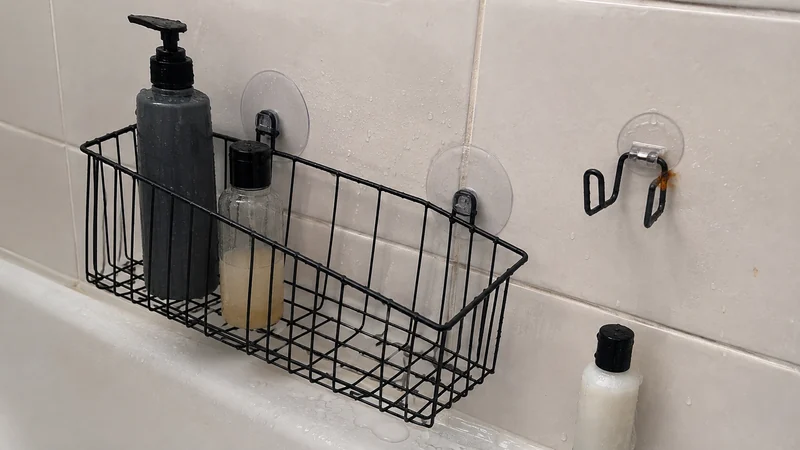
Start with the first thing that moved
“The caddy fell” describes the ending, not the failure. A suction cup can lose its seal. A showerhead hook can rotate. A lower stabilizer can miss the tile. A tension pole can be outside its span or sit on uneven contact points. A shelf can also look unstable because the bottle load is high, off-center, or too tall for the opening.
Empty the organizer before troubleshooting. Do not keep adding pressure, adhesive, or weight to a mount that is already moving.
Use the failure pattern to choose the next check
| What happened | Inspect first | Reversible next step | Do not assume |
|---|---|---|---|
| Suction cup released | Surface texture, grout, residue, cup condition, and exact setup sequence | Clean and dry only as the manufacturer directs; relocate to uninterrupted compatible surface | More force or an extra adhesive will make an incompatible surface safe |
| Hanging caddy rotates or slides | Hook-to-pipe fit, collar, lower stabilizer, grout alignment, and load balance | Empty it, reseat the approved hook, and verify the lower contact lands flat | The pipe alone controls rotation |
| Tension pole leans, bows, or drops | Exact vertical span, pole assembly, contact-point flatness, alignment, and load | Empty it and recheck the product's measured range and sequence | A taller or more expensive pole fits every ceiling |
| Shelf tilts under bottles | Shelf lock, bottle height, total load, and left-right balance | Remove the heaviest or tallest items and restore a centered light load | More shelves mean unlimited usable capacity |
| Orange or brown residue appears | Joints, fasteners, coating damage, trapped water, and nearby metal objects | Clean, dry, and isolate the source before reloading | A “rustproof” frame means every component and nearby object is immune |
| Water or soap collects | Drainage slots, wall contact, bottle footprint, and cleaning access | Remove items, clear the path, and reposition within instructions | An open-wire design cannot trap residue anywhere |
Suction failure usually starts at the interface
OXO's StrongHold corner-basket guidance specifies smooth glazed surfaces and cups positioned away from grout. That means a cup spanning a grout line or sitting on textured, porous, curved, or contaminated material has not met the basic mounting condition.
Inspect the cup for damage and the wall for soap film or scale. Follow only the exact cleaning and activation sequence for that product. If there is no large enough compatible surface, reject the suction lane instead of improvising a permanent attachment.
A hanging caddy needs a second point of control
The showerhead hook carries the unit, but a lower stabilizer helps control rotation and wall movement. If that pad lands on grout, a curve, or a recessed tile pattern, the basket can swing even when the top hook remains attached.
Empty the shelves and check whether the hook sits fully around the pipe without resting on an incompatible collar. Then check where the lower contact actually lands. Reload from the bottom up and keep heavy bottles close to the center.
Do not overtighten or add a clamp unless the manufacturer includes and directs it. The showerhead and plumbing are not test fixtures for an improvised load.
A tension pole can stand and still be the wrong fit
The current simplehuman 8-foot tension caddy publishes a 5-to-8-foot range and uses a spring-loaded pole with grippy feet. The actual corner still needs flat, stable contact at both ends and a straight installation line.
If the pole leans or bows, remove the load. Recheck the raw span at the precise contact line, the section assembly, the ceiling and floor surfaces, and the manufacturer's compression sequence. A ceiling slope, shower-pan curve, loose section, or off-center load can turn a nominally in-range height into a poor installation.
TechGearLab's broader panel found that tension formats can take more assembly and may flex. That is a useful warning to inspect alignment and movement, not a performance verdict on the exact simplehuman option.
Treat “rustproof” as a scoped material claim
Manufacturers may describe a frame as anodized aluminum or stainless steel. That does not identify the source of every orange mark in a wet assembly. A fastener, weld, coating chip, nearby razor, bottle ring, mineral deposit, or transferred residue can be the source.
Remove the items and inspect the highest point where the mark begins. Clean and dry according to the product and surface instructions. Photograph the area before and after so a recurring source can be distinguished from a one-time deposit. Replace damaged hardware only with approved parts.
This visual check does not identify an alloy, guarantee corrosion resistance, or establish a warranty claim. Contact the manufacturer when the exact product shows recurring material change.
Drainage and cleaning are stability inputs
Soap film and hard-water residue can affect wall contact, shelf angle, bottle footing, and cleaning access. Keep drainage openings clear and leave space to remove the organizer without striking controls or glass.
During a scheduled clean, unload the caddy, inspect every contact and joint, and check the wall behind it. Returning fewer items may be the correct fix when the original load exceeded the format's useful capacity.
What this diagnostic cannot prove
An empty-and-reload check cannot establish long-term holding strength, corrosion life, adhesive safety on an unknown finish, or structural capacity. It should not override the manufacturer's installation, load, cleaning, or warranty instructions.
If the correct surface, geometry, span, and load still do not produce a stable installation, stop using that mounting format. A fall in a wet shower can damage the organizer, tile, glass, plumbing, or a person.
Bottom line
Trace the failure backward. Suction problems begin at the cup-and-surface interface. Hanging rotation begins with hook and stabilizer geometry. Tension movement begins with span, alignment, contact, and load. Rust-colored residue requires source inspection rather than a broad material assumption.
If the current mount is incompatible, return to the shower-caddy mounting guide and compare the exact options in the research shortlist.