
Start with where the suitcase will open
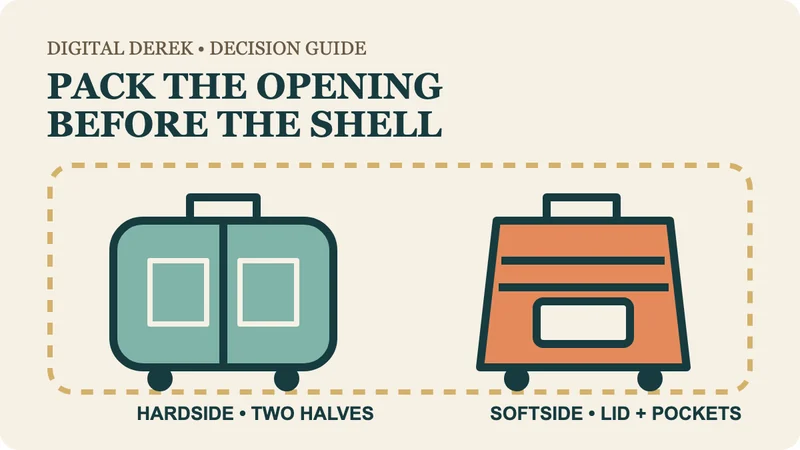
A hardside carry-on commonly opens into two halves. A softside carry-on commonly opens through one main lid and may add exterior pockets. That geometry changes packing on a hotel rack, in a small room and during a quick airport repack before shell material settles the decision.
| Your priority | Useful starting path | Check before buying |
|---|---|---|
| Divide belongings between two enclosed halves | Hardside | Whether you have room to open both sides flat |
| Reach a document or small item without opening the main case | Softside | Pocket dimensions and whether a loaded pocket adds depth |
| Keep a fixed outer shape around the contents | Hardside | Shell material, corner protection and internal dividers |
| Use one lid over a deep packing compartment | Softside | Zipper path, frame structure and fabric care |
| Meet a specific airline limit | Either | Full outside dimensions, including wheels and handles |
Consumer Reports describes that common split: hardside luggage often uses a 50/50 clamshell that needs more floor area, while softside bags tend to offer flexibility, expansion and exterior access. Its guidance also warns that shell materials differ; “hard” is not one durability specification. Travel + Leisure's current category comparison draws from testing notes across more than 500 suitcases, but the best layout still depends on the room and trip.
Two Travelpro examples isolate the shell choice
Travelpro lists its Maxlite Air V2 Carry-On Hardside Spinner with a 100% polycarbonate shell, two interior divider panels, a built-in lock and 2 inches of expansion. Its overall dimensions, including wheels and carry handles, are 23 by 14.5 by 9.5 inches; listed weight is 6.7 pounds and volume is 46 liters.
The Maxlite 5 Carry-On Spinner is a polyester softside example with an exterior full-length lid pocket, side accessory pocket and up to 2 inches of expansion. Travelpro lists its overall dimensions at 23 by 14.5 by 9 inches, weight at 5.4 pounds and volume at 46 liters.
These examples have the same listed volume and similar outside dimensions. The useful differences are opening style, pocket access, shell and weight. Compare those features on the exact bags you are considering, along with price and your airline's size limit.
Match the bag to your airline's size limit
Both exact examples are 23 inches tall overall. Travelpro says they were sizer-bin tested for most major US airlines, while also warning that an expanded bag may not meet restrictions. A current airline rule can be smaller, and route or aircraft rules can differ.
Before buying, open the carrier's own baggage page for the exact itinerary. Compare height, width and depth in the same order, and include wheels, handles and any bulging exterior pocket. If a dimension is over the stated limit, a marketing label cannot make it compliant.
Expansion is a return-trip risk as well as a convenience. Fill the bag with the real packing list, zip the expansion closed if airline fit is tight, and weigh the finished case. Compression changes bulk, not mass.
Test the layout with what you own
Lay the travel wardrobe on the floor in the shape of one deep compartment, then divide it into two shallow halves. Add the items you would want before landing: medication, charging cable, document pouch or light layer. This free rehearsal reveals whether a clamshell's separation or a soft lid and outside pocket reduces friction.
If clothing organization is still the constraint, use the packing-cube fit test before changing suitcases. Cubes can organize either shell, but their loaded dimensions still have to fit around wheel housings and handle channels.
Choose the opening you can use in the real room
Choose hardside when a two-sided interior and fixed shell suit your packing space and handling priorities. Choose softside when one main compartment, exterior access and lower listed weight in a comparable example solve the trip more directly. Then verify the exact outside dimensions against the airline and keep expansion out of the fit assumption.