
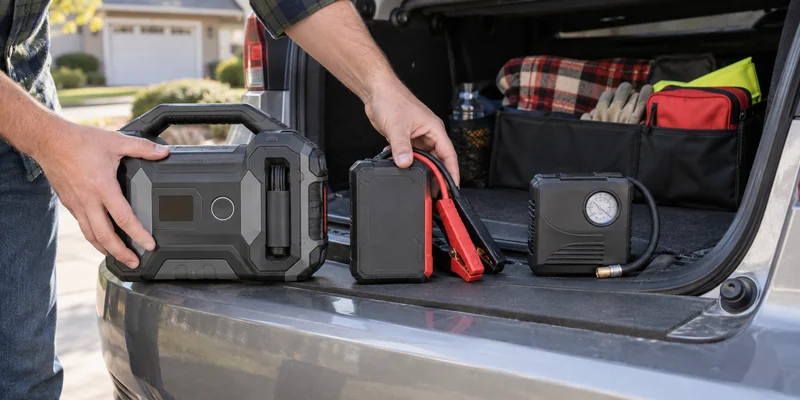
Buy the emergency plan, not the number of features
A dead 12-volt battery and a low tire are separate roadside problems. A combo tool can cover both in one package, but its shared battery and charging routine become part of both jobs. Separate tools take more inventory while letting each function keep its own power, limits, and replacement path.
| Your situation | Better starting route | What changes the answer |
|---|---|---|
| Small trunk, occasional passenger-car emergencies | Combo jump starter and inflator | Exact engine and tire limits, stored charge, total weight |
| One suitable tool is already owned | Add only the missing function | Avoid paying to replace a job you already cover |
| Larger tires or repeated inflation | Separate inflator selected for that duty | Power connection, airflow, duty cycle, hose reach |
| Redundancy matters | Separate tools | Two readiness checks and more storage space |
| A battery repeatedly goes flat or a tire repeatedly loses pressure | Diagnose the cause first | An emergency tool does not repair the fault |
One current product family makes the tradeoff visible
NOCO's US documentation provides a useful same-brand example. The AX65 combo specifications list a 31.8 Wh rechargeable battery, a 2,000 A peak starting label, a 67 L/min maximum airflow label at zero pressure, and a 6.95 lb product weight. Its manual-mode compressor duty cycle is five minutes on and 30 minutes off. The AX65 data sheet says the jump and inflation functions are not used simultaneously.
For a separate route, the GB50 jump-starter specifications list a 35 Wh internal battery and a 2.71 lb manufacturer-listed weight, while the AIR10 compressor specifications list a 5.39 lb tool that draws from a suitable 12-volt vehicle outlet. Packed together, those manufacturer-listed weights total 8.10 lb. Separate does not automatically mean lighter; it means the two functions are chosen and maintained separately.
These examples do not establish performance or durability. They show why the buying decision needs more than a peak-amp or maximum-PSI headline.
Decide which kind of readiness you can maintain
A combo gives you one unit to locate and recharge. That simplicity is valuable only if the pack stays within its storage guidance and has enough charge when either job occurs. If the shared battery is unavailable, both functions are unavailable.
A separate rechargeable jump pack plus a vehicle-powered inflator creates two different energy paths. The jump pack still needs charge. NOCO's AIR10 support page says the vehicle must be on and its 12-volt port needs the specified electrical support. That can be useful for inflation without another stored battery, but it is not a universal solution for a vehicle that cannot safely power the outlet.
Match the tire job as carefully as the engine
Maximum PSI does not tell you how quickly a tool will fill your largest tire, how long it can run, or how hot it becomes. Record the largest tire size, normal cold-pressure target, worst realistic starting pressure, and whether the job is a small top-off or a near-flat refill.
Then record the vehicle's battery system, engine size, approved jump points, and manual instructions. Do not assume an EV's high-voltage traction battery can be jump-started; follow the exact vehicle procedure for its separate low-voltage system.
What spending more needs to buy
For a combo, a higher total needs to buy a verified fit for both jobs, usable controls, sensible storage, and a charging routine you will follow. For separate tools, extra cost should buy a material improvement in the demanding function—such as a suitable inflator duty cycle or a jump pack that fits the vehicle—not duplicated flashlights and USB ports.
AAA's roadside kit guidance lists a portable jump starter and a tire inflator as separate useful kit items. That supports covering both problems, not one universal product format.
If one tool is already suitable, add the missing job. If compact storage and one readiness check matter more, compare combo specifications against your exact vehicle and tire. If independent replacement or power paths matter more, keep the tools separate. Continue with the existing portable jump-starter comparison and portable tire-inflator comparison for the function-specific checks.