
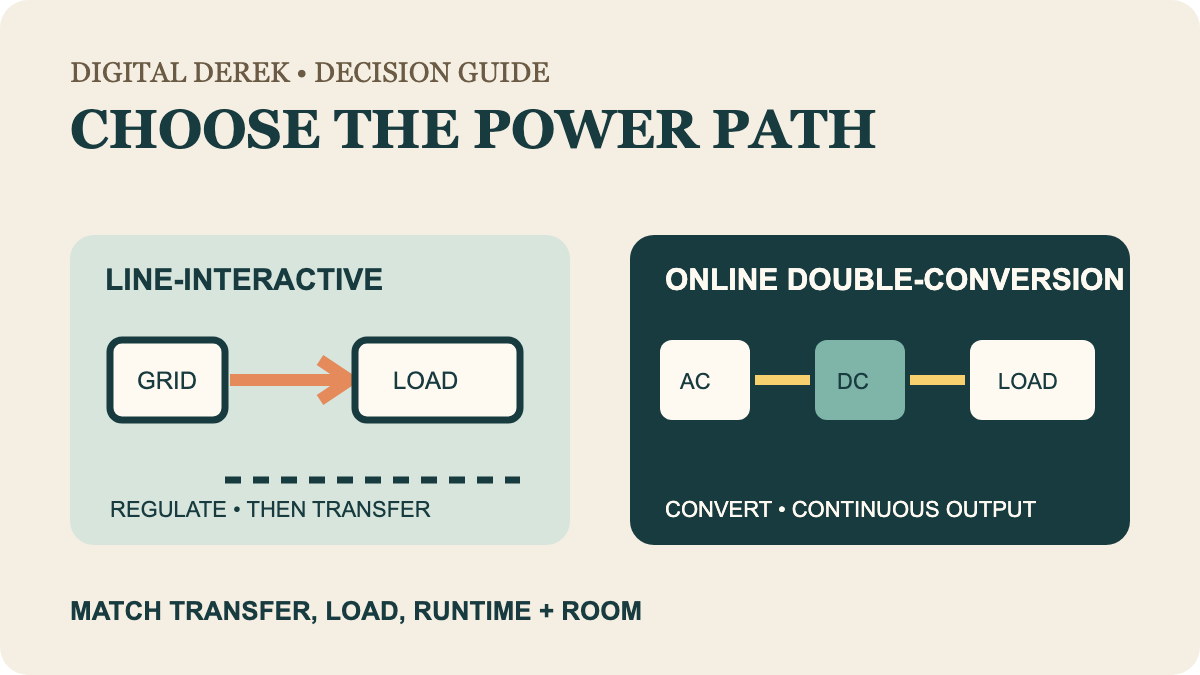
Choose the power behavior your equipment requires
For a home office, NAS or small network closet, start with line-interactive unless the protected equipment or operating requirement calls for continuous conversion. Line-interactive UPS units regulate common voltage changes and switch to battery when input leaves their accepted range. Online double-conversion units continuously rebuild AC output through an AC-to-DC-to-AC path, so battery takeover does not require an output transfer.
| Requirement | Useful starting path | What to verify |
|---|---|---|
| Desktop, NAS or router can tolerate a brief transfer | Line-interactive | Exact transfer-time specification and equipment behavior |
| Zero transfer time is an operating requirement | Online double-conversion | Normal operating mode, not an efficiency or bypass mode |
| Frequent high or low utility voltage | Either, model dependent | Input window, regulation behavior and battery use |
| Long outage runtime | Either, properly sized | Runtime curve at the actual load and battery-expansion support |
| No tolerance for fan noise or extra heat | Do not choose by topology alone | Exact acoustic, efficiency and ventilation specifications |
Eaton's topology guide distinguishes voltage-regulating line-interactive designs from continuously converting online designs. Vertiv's topology explanation describes the same power paths and notes that line-interactive transfer includes a brief break while online double conversion does not.
A controlled 120-volt example
Eaton's 5P1500RTG2 is a 120-volt line-interactive rack/tower model rated at 1,440 VA and 1,440 watts. Eaton lists automatic voltage regulation, pure-sine-wave battery output and a typical 10-millisecond transfer. Its maker runtime figures are 15 minutes at half load and 5 minutes at full load, but those figures apply to Eaton's stated test loads—not to every desk.
The Eaton 9SX1500 is a 120-volt online double-conversion tower rated at 1,500 VA and 1,350 watts. Eaton lists six 5-15R outlets, a 5-15P input, 51 dBA at one meter and support for extended battery modules. The 9SX brochure identifies zero transfer time in online mode.
These examples show why topology and load rating deserve separate checks: the line-interactive model has the higher watt rating here. Match the power path, usable watts, form factor and runtime to your equipment.
Treat bypass and efficiency modes as different states
An online UPS may include bypass or high-efficiency behavior that changes the active power path. If zero transfer is the reason for buying, confirm which mode delivers it and how the unit responds to faults, overload and maintenance. Do not use the word “online” as a substitute for reading the operating-mode table.
The same care applies to line-interactive specifications. “Automatic voltage regulation” does not state the full accepted input range, transfer timing or compatibility with every power supply. Confirm the exact model and firmware-supported shutdown method.
Size the load before choosing the topology
Add the devices that must remain powered, then measure or conservatively estimate their working load. Leave displays, speakers and chargers off the battery group unless they are required. Compare the result with both watt and VA ratings and use the maker's runtime curve near that load.
A model's full-load runtime is not a target operating point. Allow headroom for startup behavior, future equipment and battery aging. Test the shutdown path after installation without risking open work or a production service.
Know when the more expensive path earns its place
APC's guidance for automatic transfer switches recommends double conversion because line-interactive output behavior can cause nuisance switching in that specific arrangement. That is a specialist reason, not evidence that every home office needs online conversion.
Choose line-interactive when the load tolerates its documented transfer and you want a simpler everyday backup path. Choose online double-conversion when zero-transfer output and continuous conditioning solve a defined requirement. If the larger decision is battery role rather than topology, compare a UPS with a portable power station first.