
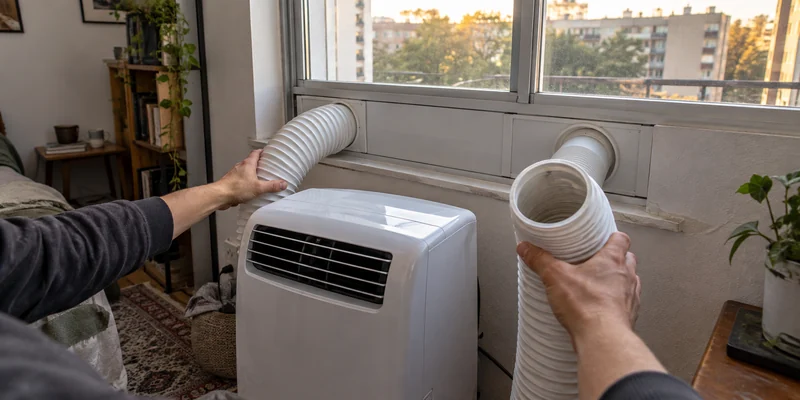
Start with the window you can actually seal
A portable air conditioner still needs a supported route for moving heat outdoors. Measure the window opening, check how the panel will lock in place, and confirm that the hose path will not be crushed or sharply bent. If a permitted window unit fits, it may keep the appliance and hoses off the floor; compare that route before paying for portability.
| Your constraint | Where to start | What to confirm |
|---|---|---|
| The room has space for two ducts and the supplied panel | Dual-hose portable AC | Intake and exhaust openings, panel range and required clearance |
| The opening or floor plan only supports a simpler duct route | Single-hose portable AC | Sealing, make-up air, SACC and exhaust-hose placement |
| A supported window unit can stay installed | Window AC | Permission, support, opening size and electrical instructions |
| The room feels damp rather than hot | Measure humidity first | Cooling and moisture control are different jobs |
The second hose changes the condenser-air path
The US Department of Energy defines a single-duct portable AC as drawing condenser inlet air from the conditioned room and exhausting it outside. A dual-duct design draws condenser air from outdoors through a duct and sends it back outdoors through another duct. That separation can reduce the amount of conditioned room air used for the hot side of the appliance.
The useful caution is that duct count does not rank two finished products. Cabinet design, controls, hose heat, sealing and the tested cooling rating still matter. A compact single-hose unit with a suitable SACC can fit a small room better than a bulky dual-hose model whose panel or clearances do not fit.
Compare SACC to SACC
Portable AC packaging can show more than one BTU figure. DOE's portable-AC test procedure uses seasonally adjusted cooling capacity, or SACC, for represented cooling capacity. Keep the rating basis attached whenever you compare models; a larger number under a different method is not an equal comparison.
Use SACC to narrow the capacity range, then return to the room. Sun exposure, ceiling height, open doorways, insulation and heat-producing equipment can change the load. Use the room-area range as a starting point and allow for the heat load in your space.
Price and place the whole installation
Check what the exact model includes: window panel pieces, hose adapters, drain hose, remote and any model-specific hardware. Confirm the panel's supported opening range and whether your horizontal or vertical window needs another approved arrangement. Leave the manufacturer's required space around the cabinet and exhaust path.
Drainage can also change the daily routine. Follow the exact manual for cooling, dry and heat modes; a statement about one mode or climate does not transfer to every condition. Keep the unit on the wall connection and circuit arrangement specified by its manufacturer.
Choose the duct layout after the room plan
Choose dual hose when the separated condenser path serves the room and the complete two-duct installation fits cleanly. Choose single hose when its simpler physical route and same-basis SACC fit the job. If the window can safely support a room unit, the window AC versus portable AC guide compares that more fundamental installation decision first. If moisture is the real problem, use the dehumidifier sizing guide before adding cooling equipment.