
Start with the moisture source, not square feet
To learn how to size a dehumidifier for a basement, start with two separate questions:
- Is the problem airborne humidity, or is liquid water entering the space?
- What are the basement's area and untreated moisture condition?
A portable dehumidifier can remove water vapor from the air. It is not the repair for flooding, seepage, a plumbing leak, failed exterior drainage, sewage, wet building materials, or a mold-remediation need. EPA says moisture control starts with fixing the source and acting promptly when materials get wet.
If possible, EPA recommends keeping indoor relative humidity below 60% and ideally between 30% and 50%. Use a humidity meter to check how your basement responds toward that target.
If humidity is already controlled and the remaining issue is airborne dust, use the air purifier versus dehumidifier comparison before sizing another moisture-removal appliance.
Account for a cool basement before sizing
Match operating temperature before increasing capacity. Check the model's operating range and low-temperature performance for your basement conditions. Use the desiccant versus compressor comparison to distinguish temperature limits from rated extraction, then return to sizing for the area and moisture load.
Use the current pint rating
Dehumidifier capacity is labeled in pints per 24 hours under specified test conditions. ENERGY STAR explains that current portable units are tested at 65°F rather than the older 80°F condition. Cooler air contains less removable moisture, so the same or similar hardware can carry a lower current pint number than an old model did.
That means an old 50- or 70-pint label should not be compared directly with a current 50-pint label as if the numbers came from the same test. Compare current models under the current standard and treat any old-to-new conversion as an approximation, not an exact product match.
Also keep rated daily capacity separate from bucket volume. A unit can be rated to remove many pints per day but hold only a fraction of that water before it shuts off for emptying.
Record the five inputs that change the job
1. Floor area and connected zones
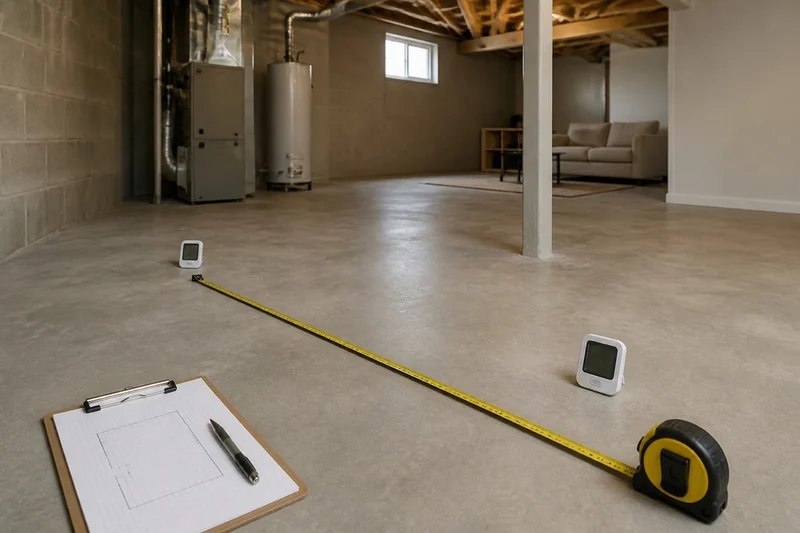
Measure each rectangular basement section and add the areas. Record whether doors normally stay open, whether stairways connect to conditioned space, and whether closed rooms have their own air movement. One unit in an isolated utility room may not represent humidity in a distant finished room.
Record ceiling height and unusual open volumes too. ENERGY STAR's portable starting chart uses floor area and dampness, but the actual air volume and layout still affect placement and circulation. Do not invent a precise percentage adjustment from ceiling height alone.
2. Untreated relative humidity and dampness
Use at least two separate RH/temperature monitors. Log the readings before the dehumidifier runs, including a rainy or humid period when possible.
Match the space honestly:
- Slightly to moderately damp: feels damp or has an intermittent musty odor; roughly 50–75% RH in ENERGY STAR's current description.
- Very damp: consistently feels and smells damp, with damp spots; roughly 75–90% RH.
- Wet: walls or floors sweat, seepage is present, or a high-load activity such as laundry drying adds moisture; roughly 90–100% RH.
The wet category is also a warning to investigate the water source. A larger appliance is not permission to ignore seepage.
3. Basement temperature
Record temperature with every RH reading. Current capacity testing uses 65°F, but a basement may run cooler. Frost and defrost cycling can reduce useful water removal, so verify the exact model's operating range instead of assuming a warm-room result will transfer.
4. Ongoing moisture loads and air exchange
Note laundry drying, an unvented dryer, showers, open windows, HVAC behavior, exterior-air exchange, sump conditions, and frequently opened doors. These can change the ongoing load after the initial moisture is removed.
5. Drainage and bucket handling
Plan where the water goes. A gravity hose needs a continuous downhill path to an approved lower drain. A full bucket must be liftable and carryable on the actual route. Water that must move upward requires a pump plan and a realistic service/failure response.
Drainage does not change the unit's rated pints per day. It changes how long the unit can operate before human action or a water-handling failure stops the job.
Read the current ENERGY STAR starting ranges
ENERGY STAR's current portable-dehumidifier guidance separates spaces below and above 2,000 square feet, then adjusts by untreated dampness:
| Untreated condition | Below 2,000 sq. ft. | Above 2,000 sq. ft. |
|---|---|---|
| Slightly to moderately damp | 20–30 pints per day | 30+ pints per day |
| Very damp | 25–40 pints per day | 40+ pints per day |
| Wet | 30–50 pints per day | 50+ pints per day |
Use this as a minimum starting range, not a promise. ENERGY STAR also notes that oversizing is generally safer than undersizing, but the decision still has to account for temperature, layout, source control, drainage, noise, energy, and the actual operating plan.
What size dehumidifier for a 1,000 sq. ft. basement?
There is no honest single answer from the area alone.
- A slightly to moderately damp 1,000-square-foot basement begins in the current 20–30-pint range.
- A very damp 1,000-square-foot basement begins in the 25–40-pint range.
- A wet 1,000-square-foot basement begins in the 30–50-pint range—and the liquid-water source needs investigation before the purchase.
A cooler space, connected rooms, continuing laundry load, poor air movement, or an impractical bucket route can push the decision toward a different setup. Use readings over several typical days to distinguish a temporary spike from a recurring moisture load.
Run the 72-hour sizing worksheet
Use this before choosing an exact product.
| Input | What to record | What changes the plan |
|---|---|---|
| Moisture source | Leaks, seepage, wet materials, sump, gutters, grading, plumbing | Active liquid water or wet materials that need repair or professional action |
| Area and zones | Section dimensions, doors, stairs, utility rooms, finished rooms | One-unit placement cannot circulate through the intended connected space |
| RH and temperature | Two monitors, morning/evening readings, weather/context for 72 hours | Readings or temperatures outside the proposed exact unit's useful operating plan |
| Drainage | Lower drain, hose length, continuous slope, outlet, crossings | Water must travel upward without a pump plan, or the route creates a leak/trip risk |
| Bucket handling | Published bucket volume and a same-volume carry simulation | Full or partial bucket cannot be lifted, carried, or emptied safely |
| Maintenance | Filter access, coil cleaning, hose inspection, recall check, service path | The unit cannot be maintained or the exact model is recalled |
Do not average away a problem location. If one monitor stays materially wetter, the layout, airflow, or moisture source needs separate attention.
When a different moisture solution fits better
Pause the portable-product search when:
- active flooding, seepage, sewage, a plumbing leak, or persistently wet materials are present;
- the basement is part of a larger whole-home humidity problem;
- the intended space exceeds the portable guidance or requires ducted air distribution;
- electrical, drainage, sump, or installation work exceeds a safe homeowner plan;
- a correctly operated unit cannot approach the target despite source control;
- visible growth, health concerns, or substantial water damage requires the appropriate professional evaluation.
ENERGY STAR recommends professional sizing and installation for a whole-home dehumidifier. Do not turn a portable square-foot chart into a ducted-system design.
Common sizing questions
Is a 50-pint dehumidifier better than a 35-pint model?
Not automatically. A 50-pint unit has more rated capacity, which may help in a larger or wetter space, but footprint, sound, heat, bucket weight, drainage, energy, and cycling behavior still matter. Start with the current condition- based range and compare exact models under the same rating standard.
Can a basement dehumidifier be too large?
A larger portable unit may reach the target faster, but it can also cost more, occupy more space, create more noise or heat, and use a heavier bucket. ENERGY STAR says it is generally better to oversize than undersize; that does not make every larger unit the best fit for every basement.
Does using a drain hose change the required capacity?
No. A hose does not change the nameplate pints per day. It can make continuous operation practical by removing bucket-emptying interruptions when a safe lower drain exists.
What humidity should I set in a basement?
EPA's general guidance is below 60% when possible and ideally 30–50%. Use a separate monitor and watch how the space responds. The exact target also has to be realistic for the building, season, and moisture source.
Does a cold basement need a different dehumidifier?
It can. Cooler air reduces water-removal performance and can trigger frost or defrost behavior. Verify the exact unit's operating-temperature guidance and do not rely on a warm-room test or a square-foot claim alone.
Choose products only after the worksheet passes
Once the source, measurements, capacity range, bucket route, and drainage plan are clear, compare basement dehumidifiers by drainage plan. That comparison separates a current exact large-space research lead from two replacement variants whose predecessor test results should not be transferred automatically. With the worksheet complete, you can compare products by the capacity, temperature, drainage, and handling job your basement actually needs.
Check the cost of maintaining the room
Once the machine can reach and maintain the desired humidity, record its electricity use over a representative period. Include normal compressor cycling and distinguish an initial dry-out from ongoing maintenance. The dehumidifier running-cost calculator and guide turn those readings into an estimate using your own utility rate.
Separate damp air from a dry or hot room
Use the humidity reading to choose the right job. A dry room calls for adding moisture: ultrasonic versus evaporative humidifiers compares water and cleaning routines. A room that needs cooling calls for a different installation: window versus portable air conditioning covers exhaust, floor space and capacity labels. A dehumidifier is not a substitute for either job.