
Choose where the shoes will live
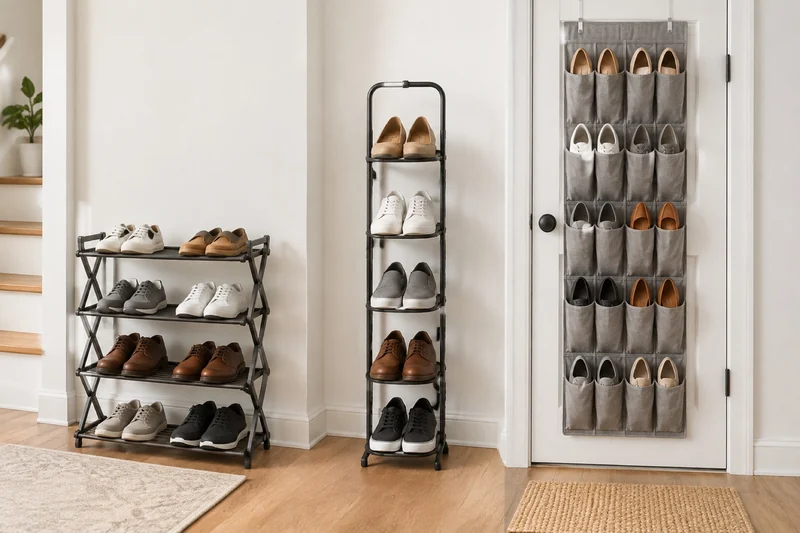
The format must solve the remaining constraint after the daily-pair edit and fit map. An expandable rack needs wall length and a clear loaded walkway. A vertical tower trades capacity for a small footprint. An over-door organizer uses the door but must not compromise that door's normal operation.
Use the before-you-buy organizing guide and narrow-entryway fit map before choosing among these exact research options:
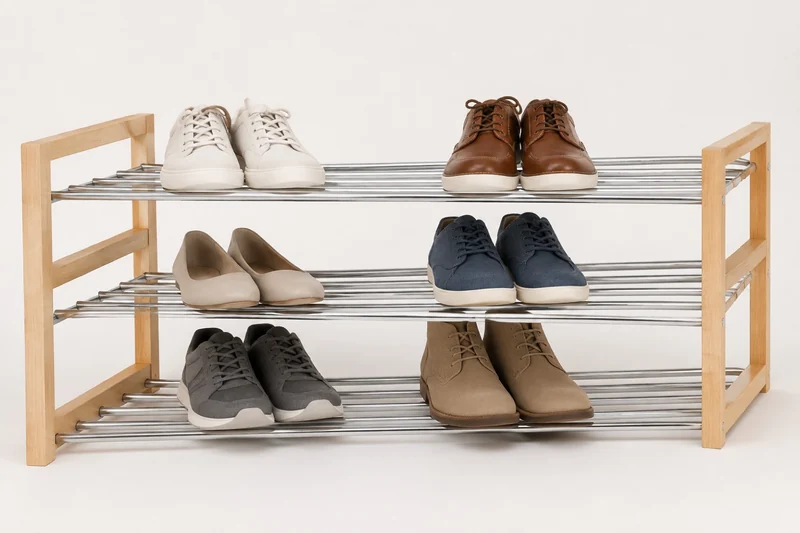
- Whitmor 3-Tier Expandable Shoe Rack : an open adjustable-width option for ordinary shoes.
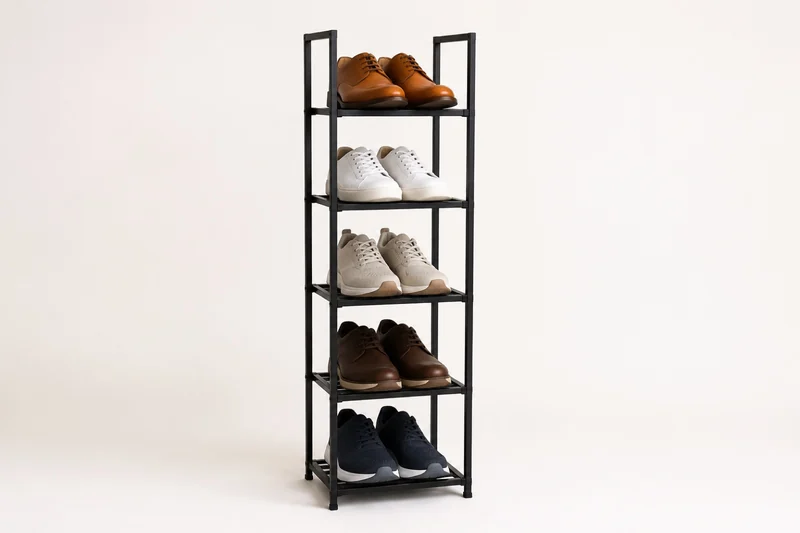
- Yamazaki Home Tower Shoe Rack, Tall : a premium five-pair vertical option for a very small floor footprint.
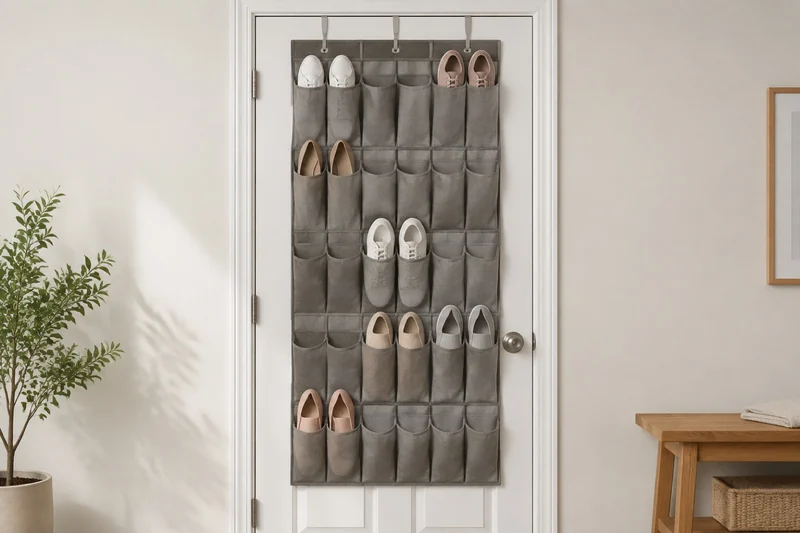
- Gorilla Grip Over-the-Door Shoe Organizer : a no-floor-space option for compatible doors and pocket-sized shoes.
Match the product to the real job
This is a routing table, not a first-to-third ranking.
Adjustable open option: Whitmor 3-Tier Expandable Shoe Rack
Good Housekeeping selected and tested the Whitmor three-tier expandable rack. Its panel found the metal bars workable for heels, flats, and sneakers and found the unit durable in its test, while taller boots did not fit well. The exact marketplace link resolves to ASIN `B004FLZH5I` and the natural-wood-and-chrome three-tier identity.
The adjustable width is the useful difference. It can suit a daily rotation that changes or a wall run that does not need a full cabinet. Open storage also makes each pair visible and avoids a door-opening step.
The current evidence has a specification conflict: Good Housekeeping's dimension line and the current marketplace dimension set do not describe the same order or size. Do not use either as a fit guarantee. Check the current exact variation, measure the loaded toe-and-heel projection, and reject it when the expanded frame or shoes enter the walkway.
Premium vertical option: Yamazaki Home Tower Shoe Rack, Tall
Yamazaki's current model `2478` is a five-tier steel rack with fixed shelves, an official footprint of about 7.09 by 8.66 inches, a 30.51-inch height, and a 2.2-pound stated load limit per tier. The manufacturer says it holds five pairs and fits shoes up to men's size 10. The exact marketplace listing resolves to ASIN `B00T7CSNRE`.
Good Housekeeping's test supports the role: its panel found the tower sturdy, stable, and unobtrusive in a small footprint. This is the earned premium option because it does a more specific job—five daily pairs stacked vertically on very little floor—not because its price proves better quality.
The catch is just as specific. Capacity stops at five pairs; shelves are fixed; boots do not fit the tested format; and large or smooth-soled shoes may not match the rails. The Yamazaki page showed the unit sold out at the observation, so confirm the current exact offer and return terms before acting.
Over-door option: Gorilla Grip Over-the-Door Shoe Organizer
The exact current marketplace identity is ASIN `B089WJH8G7`, a 24-pocket fabric organizer. Good Housekeeping's panel found that the tested organizer stayed in place as the closet door opened and closed, and that flats, sneakers, and clogs worked better than boots or booties.
This option earns the no-floor-space option. It can move a modest set of compatible shoes off the entry floor when a nearby closet door is otherwise unused.
“Over the door” is not a universal fit. Verify hook thickness, door-top gap, latch alignment, hinge load, wall contact, pocket stretch, reach to the top row, and the size of each actual pair. Good Housekeeping notes that larger shoes may need two pockets and that the top row can be difficult for shorter users.
A closed cabinet remains a separate option
Readers searching for hidden shoe storage may need a shallow tilt-out cabinet, not one of the three open formats. Current IKEA records illustrate the trade: the STALL cabinet is only 6 3/4 inches deep but 37 3/4 inches wide, while the BISSA is 11 inches deep and 19 1/4 inches wide. Both must be fastened to the wall.
Those products are useful fit benchmarks here, not affiliate substitutes. A closed cabinet should enter a future exact comparison only when wall width, baseboard, ventilation, shoe length, opening projection, and approved fastening all support the job.
Run a loaded doorway test
Build the maximum footprint with painter's tape and place the real daily shoes inside it. Open and close the entry and closet doors, carry a bag through the remaining path, remove every planned pair, return it, and clean around the outline.
For the vertical tower, load the highest and lowest positions. For the expandable rack, test the intended width rather than the narrowest display. For the over-door organizer, use the exact door through several slow open-close cycles before placing more weight in it.
This screen cannot prove long-term stability, capacity, material life, or door safety. Follow the exact instructions and stop using any setup that shifts, binds, tips, prevents normal latching, or damages the door or wall.
Choose storage that keeps the doorway clear
Choose the Whitmor rack when adjustable wall length matters and the loaded open format clears the walkway. Choose the Yamazaki tower only when exactly five pairs and a tiny footprint justify the premium commitment. Choose the Gorilla Grip organizer when the door—not the floor—is the verified storage surface.
If none passes the fit map, keep the before-you-buy daily rotation or investigate a properly anchored closed cabinet rather than forcing one of these formats.