
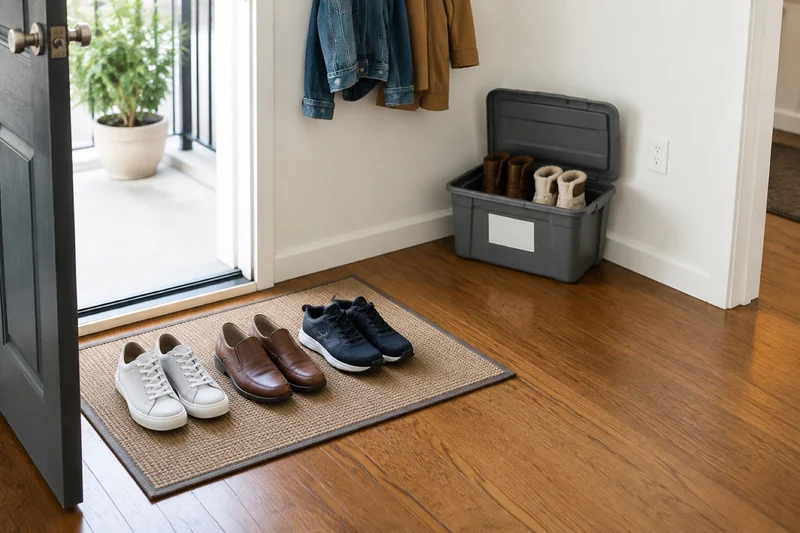
Start with the shoes that actually need the doorway
A small entryway often looks like a storage problem when it is carrying three different jobs: today's shoes, wet or dirty shoes, and the rest of the collection. A larger rack can make that mixture taller without making the routine easier.
Before buying anything, remove every pair from the entry. Set aside shoes worn in the last seven days, occasional pairs, and damaged or uncomfortable pairs that need a separate keep, repair, donate, or disposal decision. Homes & Gardens' organizer panel also starts with inventory and editing before choosing storage. Use your own everyday pair count to size the storage for your home.
Give the entryway three separate jobs
| Job | What belongs there | First no-buy setup | Failure to watch |
|---|---|---|---|
| Daily return | The few pairs currently in rotation | One marked position per pair on an existing mat or shelf | A pair has to move before another can return |
| Wet and dirty landing | Rain, snow, mud, or grass-contact footwear | A washable tray or mat already in the home | Water reaches the floor, wall, or clean shoes |
| Rotation | Occasion and off-season pairs | Existing closet shelf, box, or bin outside the entry | The pair is forgotten or requires unpacking several containers |
Do not put a wet pair straight into a closed cabinet. Let it dry according to the shoe material's care instructions and keep moisture off surfaces that can be damaged.
Protect the return path
The useful question is not “How many pairs can fit?” It is “Can every daily pair leave and return in one motion?” A storage system fails when it needs a precise stack, hides the pair behind a door that cannot open fully, or makes the walker step around shoes while entering.
Stand outside the door with a bag or coat in hand. Enter, close the door, remove a pair, and return it to the planned spot. Then repeat from inside while another daily pair is already present. Keep keys, bags, umbrellas, and packages out of the shoe zone unless the layout deliberately supports those jobs too.
Run a seven-day audit
Use the no-buy layout for one normal week. Each time a shoe lands elsewhere, record the first reason:
- Its home was already occupied.
- The spot was out of reach or hard to see.
- The door or another pair blocked the return.
- The shoe was wet, tall, or too deep for the planned position.
- The wearer ignored the storage even when it was clear.
The last failure is a routine problem, not evidence that a new organizer will work. Move the home closer to the actual drop point before adding capacity.
Decide what storage would need to change
After seven days, count only the daily pairs that genuinely need the entry. Choose a product format only when the failure is specific:
- Not enough wall length: investigate a narrow vertical rack.
- Visual clutter: investigate a shallow closed cabinet, but include door opening and wall fastening in the plan.
- No floor area: investigate an over-door organizer only if the door can still close, swing, and remain reachable.
- Changing pair count: investigate an expandable open rack with enough loaded depth and a clear walking lane.
Use the narrow-entryway fit map before accepting any advertised dimensions. If the job and space survive that check, the research shortlist compares three exact options by format.
Bottom line
Keep the doorway responsible for today's shoes, not the whole collection. Separate wet footwear, move occasional pairs out of the traffic zone, and test whether every daily pair can return in one motion. The right outcome may be a smaller collection at the door and no new storage at all.