
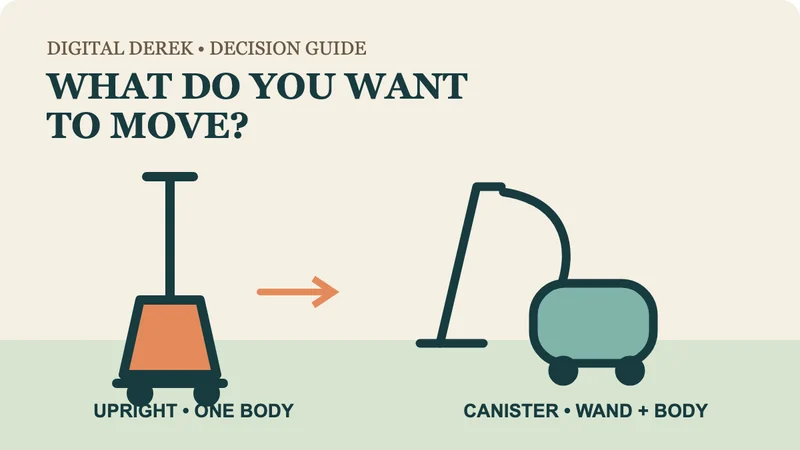
Start with the part you move room to room
An upright keeps the motor body, collection system and floorhead together. A canister leaves the main body behind you while your hand moves a hose and wand. That difference changes turning, stairs, under-furniture reach and storage more directly than the category labels predict cleaning power.
| Your home or routine | Useful starting path | Check before buying |
|---|---|---|
| Mostly open carpet or rugs | Upright | Brush control, floorhead height and steering |
| Stairs, furniture and mixed attachments | Canister | Hose reach, wand weight and where the body rests |
| Tight storage with no room for loose parts | Upright may be simpler | Fold, parking position and attachment storage |
| You dislike pulling a body behind you | Upright | Weight and resistance at the handle |
| You dislike lifting the whole cleaner for detail work | Canister | Body carry handle and hose connection |
Consumer Reports notes that uprights press a powered brush directly into carpet pile, but that category tendency is not a universal result. The exact head still matters. Wirecutter's current vacuum testing also evaluates pickup, suction, airflow and maneuverability on complete machines rather than awarding the decision to body format alone.
Compare two machines with the same floorhead family
SEBO's Felix Premium upright and Airbelt K3 Premium canister make the format difference unusually visible because both list the ET-1 12-inch powerhead with four brush-height positions. The Felix keeps the powered body in the upright and can shed its floorhead for carried detail work. The K3 puts the main body on the floor and gives your hand a separate wand and hose.
SEBO lists the Felix body at 15.4 pounds, with a 3-pound handle, a 6-foot hose and a 31-foot cord/range figure. It lists the K3 body at 12 pounds, the handle at 1.5 pounds, a 7-foot hose and a 37-foot cleaning radius from a 25-foot cord. These are manufacturer specifications, not a measured pushing-effort or stair-comfort test. A lighter handle can help one motion while the separate body creates another object to pull, park and carry.
Map the awkward route before comparing features
Walk the real cleaning route without a vacuum. Note each threshold, stair turn, low table, narrow gap and outlet change. Then mark where an upright body would need to tilt or lift and where a canister body could snag or roll into furniture.
For stairs, ask two different questions: what will your hand hold, and where will the main body sit? A canister's wand may be easier to position, but the body still needs a stable place. An upright that converts for carried work may simplify the parts count, but its full body weight still has to move between levels.
Storage deserves the same physical check. Measure the closet footprint and height, then account for the hose, wand and loose tools. A narrow upright silhouette can be easier to park. A compact canister can use a low shelf, but only if its hose and wand have a deliberate home.
Keep collection style as a separate decision
Upright versus canister answers how the cleaner moves. It does not answer whether the dirt goes into a sealed bag or reusable bin. Compare filtration, noise, capacity and recurring supplies separately.
If disposal is the sticking point, compare bagged and bagless vacuum routines next. A buyer can find bagged and bagless examples in more than one body format, so make the movement choice and emptying choice independently.
Choose the route you will finish
Start with an upright when one-piece steering across open floors is the easier routine. Start with a canister when the lighter wand and longer working reach solve more of the home's difficult edges. Then verify the exact floorhead, brush control, filter path, attachment set and replacement supplies.
Neither format is the universal winner. The useful choice is the complete cleaner whose body, hose, head and storage plan survive your most awkward room.