
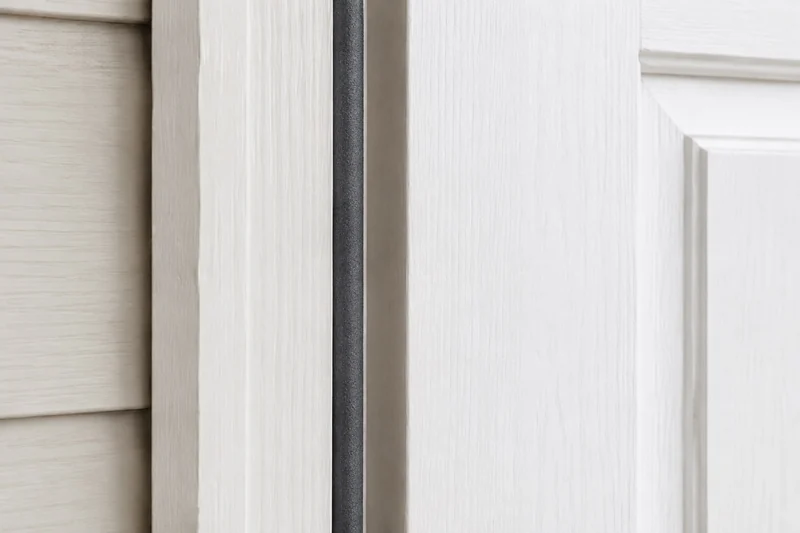
Identify the frame before choosing the material
First use the door-leak diagnostic to confirm that air is moving along the top or sides rather than under the door or behind the trim. Then inspect the doorstop with the door open. An existing slot, or kerf, points to a press-in replacement profile. No slot means the practical lanes are usually an adhesive strip or a surface-mounted seal.
Do not choose thickness by looking at the open doorway. Weatherstripping works in the closed-door contact zone. A strip must reach the gap and compress, but it must not push the door away from the stop or prevent normal operation.
Match the seal to the actual job
| What the frame and gap show | Start with | Why it fits | The catch |
|---|---|---|---|
| A clean kerf already runs along the head and jambs | A replacement kerf-in profile that matches the existing base and reach | It uses the frame's mechanical channel instead of adding another adhesive layer | A similar-looking spine or bulb can still be the wrong size; keep a cross-section of the old seal for comparison |
| A narrow seam changes as the door closes | V-strip or tension seal in a compatible location | The folded strip flexes as the moving surface meets it | Placement differs at the latch and hinge sides, and excess thickness can increase closing force |
| A small, fairly consistent contact gap on a clean surface | Adhesive foam within the manufacturer's stated gap range | It is easy to cut and can be a reversible way to test compression | Dirt, moisture, cold installation conditions, paint condition, and repeated use can weaken adhesion or crush the foam |
| The gap varies along a sound frame with no useful kerf | An adjustable surface-mounted compression seal | Slotted fasteners can let the seal be positioned against an uneven run | It needs tools, straight placement, compatible fasteners, and enough clearance for the door to operate |
| The door sags, rubs, misses the strike, or shows a changing diagonal gap | Correct the alignment first | The gap may come from hardware or frame geometry rather than missing material | Added weatherstripping can hide the cause and make the door harder to latch |
| Air moves only under the door | A bottom-specific blocker, sweep, or threshold check | Top-and-side material does not reach the bottom opening | Use the separate bottom-blocker comparison rather than wrapping jamb material around the threshold |
This table routes the repair by geometry. It does not rank brands or promise a seal on a specific door.
Existing kerf: match the profile before replacing it
A kerf is the narrow slot that holds the weatherstrip's mounting spine. The current M-D kerf-channel seal shows why the slot is a compatibility gate: its seal is designed to press into a slotted jamb, not stick onto a flat stop.
Pull only a short, undamaged section of the old seal if it can be removed without damaging the frame. Photograph the cross-section beside a ruler and compare the spine, bulb shape, reach, and orientation. A replacement that fits the slot but cannot reach the closed door is still the wrong profile.
No kerf: separate flexible seams from compression gaps
Frost King's current V-seal instructions place the folded strip on the stop across the top and latch side, but on the frame beside the molding at the hinge side. That difference matters because the door moves through the two sides differently.
The manufacturer describes foam, rubber foam, and V-seal as different material lanes rather than interchangeable upgrades. Foam depends on clean-surface adhesion and a compatible compression range. V-strip depends on its fold being positioned so the door can flex it. A surface-mounted tubular or rubber seal can be adjusted against an inconsistent run, but it trades a simple peel-and-stick installation for screws and alignment.
Use a paper pull test before and after the change
This is a fit check, not an energy-loss measurement.
- Close and latch the door normally on a strip of plain paper at the top, latch side, and hinge side.
- Pull the paper without forcing the door. Mark loose, moderate, and tight contact on removable tape.
- Repeat at several points because one side can change along its length.
- Install only a short test section when the product permits it.
- Close, latch, lock, and open the door normally, then repeat the paper check.
The Department of Energy's exterior-door job aid puts door adjustment before weatherstripping and requires the completed seal to maintain smooth operation. That is the pass/fail rule: improved contact does not count as a fix when the door becomes difficult to use.
Stop adding thickness when the door operation changes
Remove or reject the trial strip if the door must be slammed, held, lifted, or pushed to latch; if the deadbolt no longer aligns; or if the material folds, tears, or pulls out during normal movement. Check loose hinges, the strike, frame condition, and the original seal profile before trying a thicker layer.
The ENERGY STAR trim guidance also separates leakage at the door contact from leakage behind the trim. If the paper contact is firm but air still moves at the casing, more jamb weatherstripping is not the next repair. Older painted trim and concealed gaps can also move the work beyond a quick DIY strip replacement.
What this check cannot establish
A paper test cannot quantify air leakage, heat loss, savings, ventilation, or long-term durability. Wind, exhaust fans, HVAC operation, humidity, temperature, door movement, and seasonal frame changes can alter what happens later.
The FTC's home-energy guidance supports assessing and sealing air leaks, but it also warns against accepting unchecked savings promises. Keep the claim small: the method helps choose a compatible seal and reject one that disrupts the door.
Bottom line
Start with the existing mounting method, then match reach and compression to the closed-door gap. Reuse a compatible kerf when one exists, reserve V-strip for a suitable moving seam, treat adhesive foam as a gap-range and surface decision, and use an adjustable fastened seal only when the frame and tools support it. If normal closing, latching, locking, or opening changes, the fit failed.