
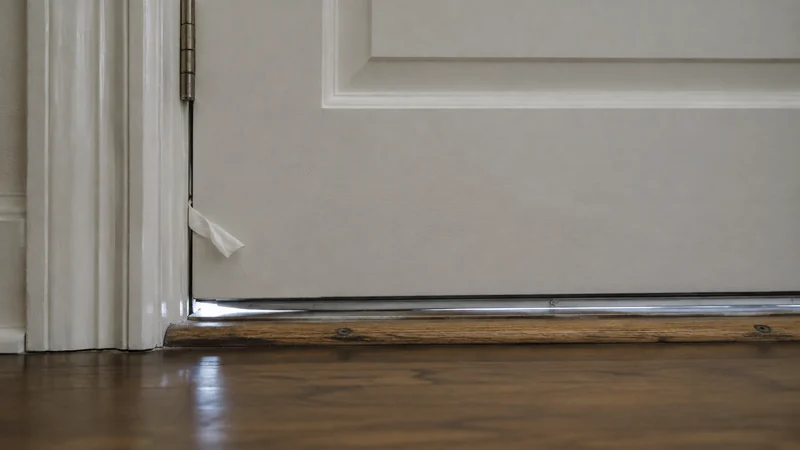
Map the leak path before changing the seal
A bottom draft stopper only addresses a bottom gap. If cold or warm air is still moving, the path may be at a threshold corner, the latch side, hinge side, top, trim, or a nearby opening that merely feels as if it comes from the door.
Do not buy a thicker stopper until you know where the air moves. Close and lock the door, look for daylight, and move a lightweight tissue slowly around the bottom, sides, top, and trim. Mark each response with removable tape. Use no flame, and stop if the door cannot close, latch, or operate normally.
Match the leak path to the next check
| What you observe | Likely lane to investigate | Why another bottom stopper may fail | Stop or escalate when |
|---|---|---|---|
| Air movement only across the open bottom edge | Threshold, sweep, or bottom-seal fit | The current piece may be too short, worn, misaligned, or incompatible with the threshold | Added material makes the door bind, prevents latching, or creates a trip or egress problem |
| Air at one or both bottom corners | Meeting point between sweep, threshold, and side weatherstripping | A straight bottom blocker may not seal the corner geometry | The frame, threshold, or door appears damaged or out of square |
| Air along the latch or hinge side | Side weatherstripping, alignment, or compression | Bottom thickness cannot close a vertical gap | Hinges, latch alignment, or closing force becomes unsafe or uncertain |
| Air across the top | Top weatherstripping or door/frame alignment | The leak is physically above the stopper | The door rubs, sags, will not latch, or needs structural adjustment |
| Tissue moves at the interior trim | Gap between the frame and surrounding wall assembly | A visible door-edge product does not reach the hidden path | The work requires trim removal, concealed-cavity access, or materials that should not be disturbed |
| The door area feels drafty but no local path is found | Nearby window, outlet, attic, basement, duct, or pressure-driven air path | The door may not be the dominant source | The home has combustion appliances, persistent moisture, damaged materials, or a broader comfort problem |
The table is a diagnostic route, not a repair prescription. A door can have more than one leak path.
Why the draft can feel like it comes from the bottom
ENERGY STAR recommends locating air leaks before sealing and notes that large hidden leaks in attics and basements can matter more than obvious doors and windows. Moving air and pressure differences can make a nearby surface feel like the source even when the actual opening is elsewhere.
Its window-and-door sealing guidance separates visible door or window gaps from gaps behind trim. That distinction is the reason a thicker sweep cannot solve every draft around a doorway.
Run the five-minute tissue map
Use a lightweight tissue or thin strip of paper. This is a location check, not a measurement of leakage or energy loss.
- Turn off nearby fans that would confuse the result, then close and lock the door normally.
- Look for daylight without forcing or modifying the door.
- Hold the tissue near the center of the threshold, then both bottom corners.
- Continue up the latch side, across the top, and down the hinge side.
- Check the interior trim and the nearest window or wall penetrations.
- Mark only repeatable movement with removable tape and record the weather, fan, and HVAC conditions.
- Repeat once under a different outdoor condition before buying a new part.
The FTC recommends assessing a home and sealing leaks, while warning consumers to be cautious about unchecked savings promises. The tissue map identifies where to look next; it does not calculate money saved or prove that a specific product will solve the problem.
When a bottom product is the right lane
A sweep, threshold seal, or fabric draft blocker may be relevant when movement is repeatable across the open bottom edge and the door still has enough safe clearance to close and latch. The exact format depends on the door material, threshold shape, floor clearance, exposure, and whether the product attaches to the door or sits loose on the floor.
Bob Vila reports researching nine draft-stopper formats and testing five. The panel includes fabric, adhesive, magnetic, and door-mounted approaches, which reinforces a useful point: match the mounting method to your own door’s gap, surface and opening path, even when a format worked well in a published test.
Once the tissue map confirms a bottom gap, use the door-draft stopper comparison to match a movable towel, slide-on sleeve, attached fabric blocker, or screw-on sweep to the door's movement, floor clearance, and permitted installation method.
When the sides, top, or trim are the real job
Weatherstripping must compress enough to reduce the gap while still allowing the door to close and latch. More material is not automatically better. If the door sags, rubs, has a damaged frame, or needs excessive force, diagnose the alignment before adding layers of seal.
ENERGY STAR describes work behind window and door trim as a more involved task. If the home may contain lead-based paint, especially in pre-1978 construction, or the work requires removing or disturbing trim, use the appropriate safety guidance or a qualified professional rather than treating it as a quick caulk job.
What the five-minute map cannot prove
The tissue response changes with wind, exhaust fans, HVAC operation, open interior doors, and pressure differences. It does not quantify leakage, identify every concealed path, determine ventilation requirements, or prove that air sealing is safe around combustion equipment.
Pause the DIY path when:
- the door will not close, latch, lock, or open normally;
- the frame, threshold, wall, or floor is damaged or wet;
- a repair could affect an exit, fire-rated assembly, accessibility, or required ventilation;
- there is a fuel-burning appliance, unusual odor, soot, alarm, or indoor-air concern near the work;
- trim or older painted materials would need to be disturbed;
- repeatable air movement remains after the visible gaps have been addressed.
Bottom line
Map the path before adding material. Use a bottom product only for a verified bottom gap, investigate side or top weatherstripping when the tissue moves there, and treat trim or whole-home paths as a different job. The best outcome may be a small adjustment, a different seal format, or no new product at all.
When the leak is at the top or sides, use the weatherstripping fit guide to match the existing frame, seal format, and closing pressure before adding material.
Before trusting a dramatic savings claim, use the checklist for evaluating online product and service evidence.