
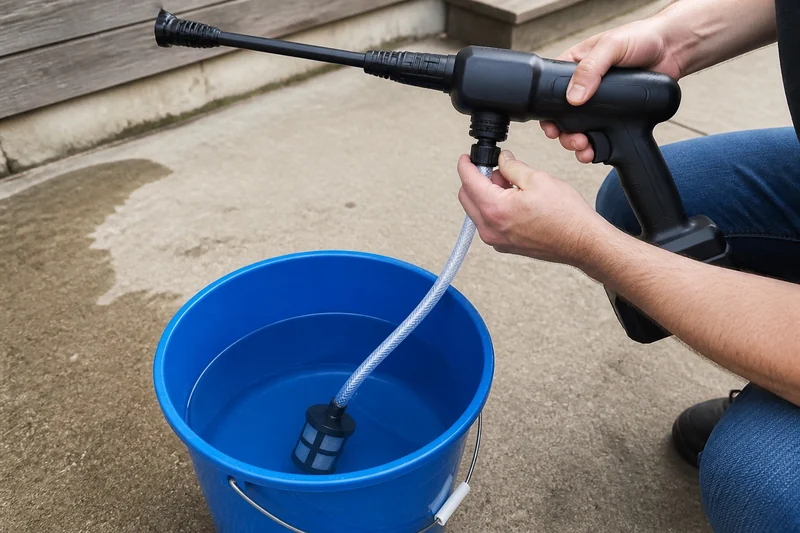
Confirm suction support before filling anything
For rinsing away from a tap, start with a cordless cleaner designed to draw clean water through a filtered suction hose. The DEWALT and WORX models below support this setup. Match the hose and priming steps to your exact model's manual; if an alternative does not document suction support, treat bucket use as unestablished.
| Model / package | Bucket connection | Battery package | Stated water flow |
|---|---|---|---|
| DEWALT DCPW550B | Filtered suction hose; manual procedure | Tool only; budget for a compatible battery and charger | 1.0 GPM |
| WORX WG644 | Included 20-foot draw hose | Manufacturer’s US kit lists two 20V batteries and a charger | 0.9 GPM maximum |
The cordless washer shortlist compares these portable cleaners with the higher-pressure cleaning class. For large paved areas, bucket convenience may matter less than the cleaning job and a continuous water supply.
Estimate whether the bucket is big enough
Four usable gallons gives about four minutes at 1.0 GPM, or four minutes 27 seconds at 0.9 GPM. That is continuous trigger-on water time—not battery runtime or a measured cleaning result.
Use usable gallons ÷ stated GPM to plan your own refill intervals. Leave space for carrying without spills and enough water to keep the intake covered. Priming, mode, nozzle and pauses change the result. A five-gallon container does not necessarily provide five usable gallons.
Check the package before buying setup parts
The model suffix matters: WG644 and a WG644.9 tool-only offer are different purchases. Match the seller’s contents list to your existing batteries before adding parts. The WORX accessories chart separates variants.
Use the complete setup-cost worksheet to price missing batteries, charging equipment and fittings once. A pictured hose or battery is not a substitute for the package list.
Set up the bucket-fed system
Follow the exact manual when it differs from this general sequence.
- Use clean fresh water. Avoid sediment, chemicals, salt water, or an unknown source unless the exact instructions explicitly permit it.
- Stabilize the container. Place a sturdy bucket on level ground where it cannot tip into the work path.
- Inspect the hose and filters. Use the supplied or approved suction hose, confirm the screen and seals are present, and clear visible debris.
- Connect the hose securely. Verify the connection without forcing or modifying fittings.
- Position the intake correctly. Keep the filter submerged in clean water but off the bottom where sediment can collect.
- Reduce the lift. Keep the tool close to the water surface and remove tight bends, pinches, and kinks.
- Prime only as directed. Use the nozzle, speed, trigger, and time stated for that model. Stop if normal flow does not begin within the documented procedure.
WORX specifically tells WG644 users to keep the intake filter just below the surface rather than on the bottom and to keep the Hydroshot no more than five feet above the water source. Its page says self-drawing may take up to 20 seconds for that model. Treat those as WG644 instructions, not universal numbers.
If the tool will not draw water
Stop repeatedly running it dry and check the manual's troubleshooting order. Common checks on current manufacturer instructions include:
- a fully seated hose connection;
- an intact, clean intake filter and gasket screen;
- no compressed or kinked section of hose;
- the filter submerged in clean water and clear of the bottom;
- the tool close enough to the water surface;
- the documented nozzle or speed selected for priming.
WORX tells WG644 users to test the unit from a household garden hose when the self-draw setup will not work, then flush and retry the suction hose if the direct connection works. Do not transfer that diagnostic sequence to another brand without checking its instructions.
If parts are missing, seals leak, the hose is damaged, the battery or contacts get wet, or the tool makes an abnormal sound, stop and use the manufacturer's support or service path.
Keep the battery and work area dry
Bucket-fed does not remove electrical and pressure hazards. Keep batteries, connections, chargers, and spare packs away from splashing and standing water. Use stable footing, control the loose hose, keep people and animals outside the spray area, and never point the stream at skin.
The CDC warns that pressure-washer spray can cause serious wounds that may initially look minor. Follow the exact manual's protective-equipment and surface guidance even when the compact tool feels less powerful than a full-size washer.
Drain and store it correctly
After use, follow the exact shutdown instructions. Both current DEWALT and WORX materials call for clean-water maintenance and draining water before storage. Remove the battery as directed, clean the intake filter, empty the hose and tool, and store everything dry and protected from freezing.
Water and detergent
Do not assume so. Use clean fresh water unless the exact manual explicitly allows another source or a specific detergent method. Sediment and unapproved chemicals can create equipment, surface, environmental, and safety problems.