
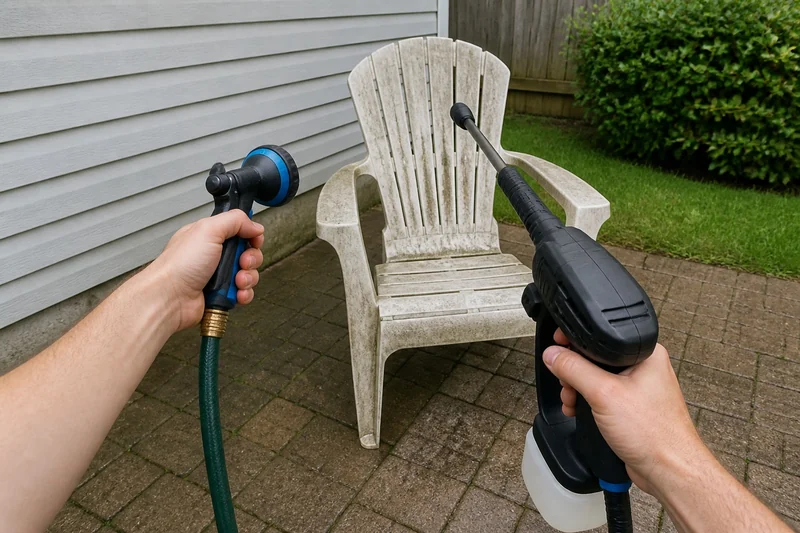
The short answer
A garden hose is the right first tool when the job is mostly rinsing, the soil is light, and a surface-safe cleaner plus modest brushing can release what is stuck. A cordless power cleaner is the middle lane: more concentrated force and better portability than a plain hose, but far less sustained cleaning output than a full-size pressure washer. A true pressure washer is for larger, tougher outdoor work where the hose-and-brush test clearly falls short.
That makes this a job decision, not a brand decision. Try the cheapest safe method on one representative patch before buying another machine.
Compare the three lanes
| Cleaning lane | Start here when… | What it adds | The catch |
|---|---|---|---|
| Garden hose, cleaner, and brush | Dirt is loose or shallow, the area is small, and the surface tolerates the planned cleaner | High water flow, simple setup, and no battery workflow | More manual effort and less concentrated force |
| Cordless power cleaner | You need a portable rinse tool, controlled extra force, or water away from a faucet | A compact wand and, on some exact models, suction from fresh water | Lower pressure and flow can make embedded or large-area work slow |
| True pressure washer | Soil is embedded, the surface is sturdy, and the area is large enough to justify setup | Much more substantial cleaning force and faster work on suitable surfaces | More storage, water, runoff, surface risk, and setup |
Manufacturers make the middle lane easy to misunderstand. DEWALT compares its 550-PSI DCPW550 power cleaner with a bare garden hose, while WORX describes the WG644 Hydroshot as a portable power cleaner rather than a whole-house or driveway machine. Those claims describe exact models under manufacturer conditions; they do not prove that every cordless tool beats every hose setup.
For the current product roles and evidence limits, use the cordless-pressure-washer research shortlist.
Run the hose-and-brush test first
Pick a test patch that represents the real job instead of the easiest corner. Photograph the starting condition, read the surface-care guidance, and confirm that the cleaner and brush are appropriate.
- Rinse away loose grit with the hose.
- Apply only a surface-appropriate cleaner as directed.
- Agitate a small area with the least aggressive suitable brush.
- Rinse, inspect from the same distance, and record the total setup and work time.
- Stop if the finish changes, fibers lift, paint loosens, or the surface guidance conflicts with the method.
If the representative patch becomes acceptably clean with modest effort, a cordless power cleaner may be a convenience purchase rather than a necessary one. If the patch barely changes, move up by tool class—not by the biggest cordless PSI headline you can find.
When a cordless power cleaner earns its place
A portable power cleaner can make sense when the obstacle is access rather than maximum force. Examples include rinsing muddy gear away from a faucet, cleaning small outdoor furniture, or reaching a spot where dragging a long hose is the main burden.
The exact water-source setup matters. Some models can use a garden hose or draw clean water through a filtered suction hose; others cannot. If remote water is the reason to buy, use the bucket-fed power-cleaner setup guide before comparing products.
When the hose is still the better answer
Keep the hose when it already reaches the work, the dirt releases with ordinary cleaning, and the tool would add charging, adapters, storage, and maintenance without changing the result. A quality nozzle and a suitable brush may solve more than a compact power cleaner when the task needs water volume and contact cleaning rather than concentrated force.
This is especially relevant for delicate or finished surfaces. More pressure is not automatically safer, faster, or more complete. Follow the care instructions for the exact surface and test an inconspicuous area.
When to skip both and use a true washer or rental
Deep concrete contamination, stripping, or a large property job can expose the limits of both a hose and a handheld power cleaner. A corded unit, true battery pressure washer, rental, or professional service may be the more efficient lane.
Do not treat renting as a failure. If the demanding job happens once or twice a year, renting can avoid battery, storage, maintenance, and underpowered-tool costs while matching the machine to the work.
Safety boundary
The CDC pressure-washer guidance warns that a high-pressure stream can cause serious wounds that initially look minor, throw objects, and create electrical hazards. Never aim a pressurized stream at yourself, another person, an animal, or live electrical equipment. Keep other people away, wear the protection required by the exact manual, and maintain stable footing.
Use the current instructions for the exact tool, nozzle, detergent, and surface. This guide does not replace a product manual, surface-care guidance, or professional help for lead paint, mold, chemicals, heights, damaged wiring, or uncontrolled runoff.
What this comparison cannot decide for you
- Manufacturer comparisons use exact nozzles and conditions; they are not a universal hose-versus-tool test.
- Water pressure, hose length, nozzle, soil, surface, cleaner, brush, and user technique can change the result.
- Current product price, availability, battery inclusion, runtime, durability, and value require separate checks.
Bottom line
Start with the hose-and-brush control. Buy a cordless power cleaner when its portable setup or controlled extra force fixes a specific limitation. Move to a true pressure washer or rental when the job is too large or embedded for the middle lane. The right answer is the least complicated tool that can finish the actual work safely.
Frequently asked questions
Is a cordless pressure washer better than a garden hose?
Not universally. A cordless power cleaner can add concentrated force and portable water-source options, while a hose can deliver a simpler high-flow rinse. The dirt, surface, area, and setup determine which is more useful.
Can a cordless power cleaner replace scrubbing?
Do not assume it can. Some soil needs a surface-safe cleaner and contact action. Use the care guidance and a small test patch rather than increasing pressure until the surface changes.
Is a 500-PSI cordless cleaner a pressure washer?
It is usually better understood as a power cleaner: a portable middle lane between a garden-hose nozzle and a true pressure washer. Product titles vary, so compare pressure, flow, water source, and intended job.
What can a cordless pressure washer clean?
Lower-output power cleaners are commonly positioned for light outdoor rinsing and spot cleaning. Larger, embedded jobs need a true pressure washer or another method. Always verify the exact tool and surface instructions first.
When light rinsing is no longer the job
For larger suitable outdoor cleaning, move to the electric versus gas pressure washer comparison. It pairs PSI with GPM and ownership work, so a high pressure claim does not hide a low water-flow rating. Full-size machines solve a different problem from a portable rinse tool.