
Choose the cleaning job before the brand
Start with the job, then choose the tool lane that can finish it:
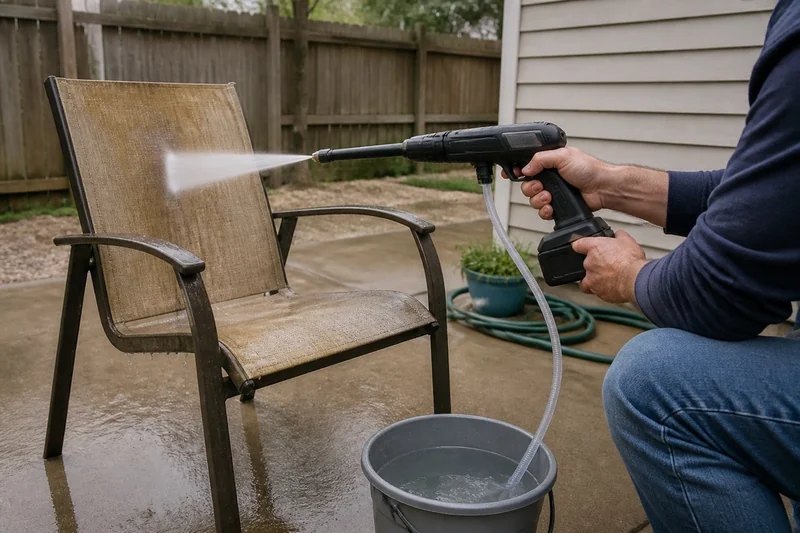
- Portable rinsing: Use a handheld power cleaner for patio furniture, bikes, muddy gear, and other controlled spot-cleaning jobs. See the power-cleaner comparison and the DCPW550B product discussion.
- Full-size battery pressure washing: Use a true pressure washer when the area is larger or the soil is more embedded. The job-by-job guide shows when this lane fits.
- Rental: For one-time deep concrete cleaning, stripping, or a large property, compare a rental before buying a handheld. The larger-job guidance covers that tradeoff.
Already owning a compatible battery system can simplify the setup, but check the exact package before assuming batteries, chargers, hoses, or adapters are included.
For either cordless option, confirm the water-source accessories and compare the complete kit or tool-only cost. Matching equipment you already own can simplify the setup; compatibility still comes first.
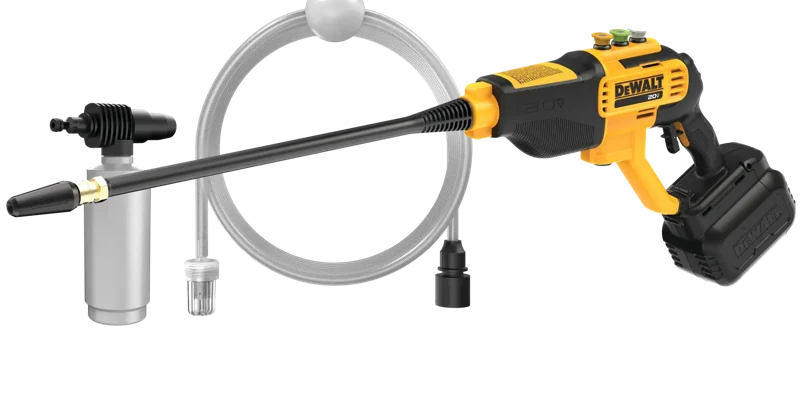
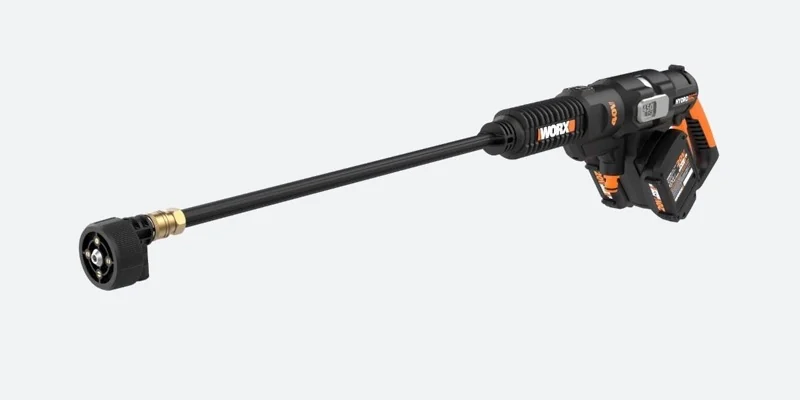
We checked the product pages for DEWALT's DCPW550B, WORX's WG644 Hydroshot, and RYOBI's RY40306BTL to identify the models. The images identify the products. They do not show Digital Derek ownership, use, cleaning results, runtime, or durability testing.
Power cleaner versus pressure washer
Pro Tool Reviews provides the most useful public category boundary in this review set: portable power cleaners commonly occupy roughly the 300-to-600-PSI range, while pressure washers generally begin around 1,500 PSI. Those are category guides, not guarantees. Flow, nozzle, distance, duty cycle, and the surface still affect useful cleaning.
| Tool option | Current examples | Best first use | The catch |
|---|---|---|---|
| Handheld power cleaner | DEWALT DCPW550B; WORX WG644 | Patio furniture, muddy gear, screens, bikes, and controlled rinsing | Lower pressure and flow can make large or deeply embedded jobs slow |
| True battery pressure washer | Ryobi RY40306BTL | Larger patios, siding sections, and more demanding outdoor maintenance | More setup, water, battery capacity, storage, and cost |
| Rental or corded control | Rental gas washer or corded electric washer | One-time deep concrete cleaning, stripping, or a large property job | Less convenient, but often a better value than owning an underpowered tool |
| Hose-and-brush control | Garden hose, surface-safe cleaner, and manual brush | Light soil or a small sensitive surface | More manual effort, but it can disprove the need to buy another machine |
The safest summary is simple: a power cleaner is a portable rinse tool with extra force; a pressure washer is a more substantial cleaning machine. Marketing language often blurs that line, so compare the exact specifications and intended job instead of trusting the category name alone.
What these categories mean for your decision
The sources cover different products, dates, and test methods. They support the tool-class distinction, but they do not create one laboratory-tested winner across every model.
| Source | What it did | Useful finding | Limitation |
|---|---|---|---|
| Consumer Reports | Measures pressure and times paint stripping; evaluates surface cleaning, noise, maneuverability, storage, and nozzle changes | Battery models improve convenience and noise, but larger jobs can take longer and require charging or battery swaps; renting can make sense for occasional deep cleaning | Exact recommendations and ratings are membership-gated, so this article does not infer a public winner |
| The Drive | Used manufacturer-supplied products and new batteries in household situations | Separates Ryobi's true-washer role from DEWALT's compact handheld role; emphasizes battery platform and ordinary-use workflow | Older, small pool without one standardized pressure-and-flow result table |
| Pro Tool Reviews | Reviews tool-specific performance and explicitly defines power-cleaner territory | Supports the power-cleaner versus pressure-washer boundary and identifies DEWALT DCPW550 and WORX WG644 as distinct handheld options | Primarily a power-cleaner roundup, not a controlled head-to-head against current true battery washers |
Across those sources, the durable finding is not a brand ranking. It is the importance of matching pressure, flow, portability, and battery workflow to the actual surface and job size.
Choose by the job you need to finish
| Your job | Start in this option | Why | Reject or escalate when… |
|---|---|---|---|
| Rinse patio furniture, screens, bikes, or muddy gear | Portable power cleaner | Compact setup and flexible water sources matter more than maximum force | Dirt remains embedded after a safe test patch |
| Wash a vehicle carefully | Hose, foam, and manual contact method; consider a power cleaner for controlled rinsing | Paint safety and technique matter more than the highest PSI | The exact vehicle or tool guidance warns against the planned nozzle, distance, or detergent |
| Maintain a moderately dirty patio or siding section | True battery pressure washer | Higher pressure and flow reduce the time penalty on a larger area | The job requires continuous runtime beyond the available batteries or water supply |
| Restore old concrete or strip heavy buildup | Rent a stronger pressure washer or hire the job out | A low-output handheld can turn a one-time task into hours of incomplete work | Surface damage, lead paint, height, runoff, or chemical handling creates a safety problem |
| Clean grout, corners, or a small bathroom zone | Use a brush or compare an electric spin scrubber | Indoor detail work is a different job from outdoor pressure cleaning | Water and electricity cannot be controlled safely |
Best-supported portable power-cleaner option
Pro Tool Reviews selected the DEWALT DCPW550B 20V MAX Power Cleaner for the combination of pressure and flow in its power-cleaner comparison. The Drive separately assigned the same exact model its compact role. DEWALT's current page lists 550 maximum PSI and 1.0 GPM with the 15-degree nozzle.
That makes the DCPW550B the strongest current portable option supported by this comparison—not a true pressure-washer winner. It is sold as a tool-only product on the official page, so battery and charger inclusion must be checked on the exact offer. Public Amazon records confirmed the ASIN identity but did not establish a current featured offer.
Best current two-battery portability alternative
The WORX WG644 40V Power Share Hydroshot is the alternative for readers who value a portable, bucket-fed setup and already use compatible WORX batteries. WORX lists 585 maximum PSI, 450 rated PSI, and 0.9 GPM for the current model, with two 20V batteries working together.
WORX also states the limitation clearly: the tool is not recommended for whole driveways or houses. That makes it easier to position honestly. It is a spot-cleaning and rinsing option, not a low-cost substitute for a full-size washer. Its exact Amazon identity was verified, but public availability was not reliably established.
True battery pressure-washer reference
The Ryobi 40V HP Brushless 2000 PSI Pressure Washer represents the true-washer option in this comparison. The current official record lists 2,000 PSI and 1.2 GPM in a wheeled frame rather than a handheld wand-only format. RYOBI also says the RY40306BTL uses two 40V 6Ah batteries and that batteries are not included.
The Drive selected the 40V Ryobi format for its true battery-washer role, but that does not make it directly comparable to DEWALT or WORX. No verified exact Amazon ASIN was resolved for the current RY40306BTL identity, so Digital Derek links to Ryobi's official page without an affiliate substitution.
Run a before-you-buy cleaning test first
Start with the safe cleaning method you already have, then identify what a powered tool would add. The cordless-pressure-washer versus garden-hose guide turns that control into a repeatable test:
- Read the surface-care guidance and the exact cleaning-product instructions.
- Define one representative test patch and photograph its starting condition.
- Try a garden hose, surface-safe cleaner, and manual brush where allowed.
- Time setup, cleaning, rinsing, and pack-away—not only the spray time.
- If the test patch improves with modest effort, a power cleaner may be convenience rather than necessity.
- If deeply embedded soil remains, move to a true pressure-washer or rental option instead of buying the strongest-sounding handheld.
Use the five-minute viral-product check when a clip makes a cordless tool look instant. Then apply the online-review evaluation method to separate exact-model testing from repeated marketing footage.
Compare more than the PSI headline
Pressure and flow belong together
PSI describes pressure; GPM describes water flow. A higher PSI number does not automatically mean a faster or better clean when flow, nozzle, and duty cycle differ. Compare both specifications inside the same product class.
Water source changes the workflow
A bucket-fed hose can be valuable away from a faucet, but the tool still needs enough clean water for the planned job. Check whether the exact model supports a bucket, bottle, garden hose, or only a pressurized source—and whether the required adapters are included. Use the bucket-fed setup guide to verify the manual, filtered hose, intake position, lift, and priming procedure.
Compare the complete kit and tool-only totals
Existing compatible batteries can make a bare tool useful, but count the packs the cleaner actually needs. The WORX family manual, pages 6 and 13, shows why: WG644 includes two batteries and a charger, while WG644.9 omits them, and operation requires two installed packs.
Compare offer price plus missing essentials and checkout charges for both routes. The kit-versus-tool-only calculator uses your own figures, so an existing battery system counts only when its compatible parts are available for the job. It does not assume either package is cheaper.
Runtime has to match the area
Manufacturer runtime claims and publisher anecdotes are not interchangeable. Estimate the area, include setup and repositioning, and decide whether one charge—or a practical battery swap—can finish the job.
Nozzle and distance control surface risk
More force is not automatically safer or more useful. Test an inconspicuous area, begin with a wider spray and greater distance, and follow the exact manual for painted, stained, composite, automotive, and soft surfaces.
Safety boundary
Consumer Reports warns against zero-degree nozzles because the concentrated stream can cause serious injury. Never direct the spray at skin, people, animals, live electrical equipment, or an unstable surface. Use eye protection, manage hearing risk, control runoff, keep secure footing, and follow the current instructions for the exact tool and surface.
This comparison is not a substitute for the product manual, local water or runoff rules, or professional guidance for lead paint, mold, chemicals, roofs, ladders, or damaged electrical equipment.
How the options compare
DEWALT is the portable power-cleaner option, WORX is the two-battery portability alternative, and Ryobi is the true pressure-washer reference. Those are decision roles, not a first-to-third ranking.
Current seller, price, stock, delivery, returns, warranty, battery inclusion, runtime, cleaning power, surface safety, and value remain offer- or test-specific. The exact links identify the verified DEWALT and WORX products; their decision roles remain bounded by the cited methods.
Frequently asked questions
What is the difference between a cordless power cleaner and a pressure washer?
A cordless power cleaner is usually a handheld, lower-pressure tool designed for rinsing and spot cleaning. A true pressure washer uses substantially higher pressure and typically more flow for larger or more embedded outdoor cleaning jobs. Compare PSI and GPM together rather than trusting the product title.
Is 500 PSI enough to wash a car?
It can provide a controlled rinse when the nozzle, distance and cleaning method suit the finish. Use the vehicle and tool guidance, a wide nozzle, conservative distance, and an inconspicuous test. A pressure stream does not replace appropriate soap and safe contact washing when those are needed.
What PSI is useful for a cordless pressure washer?
The useful number depends on the job. Roughly 300 to 600 PSI is power-cleaner territory for rinsing and light spot cleaning; true pressure washers generally start much higher. For deep concrete or stripping, a rental or stronger machine may be the more efficient choice.
Can a cordless pressure washer draw water from a bucket?
Some power cleaners can, including the exact DEWALT and WORX models in this comparison when configured with their supported hoses and adapters. Do not assume every cordless washer is self-priming or bucket-compatible; verify the exact manual and included accessories.
Choose the smallest class that can finish the real surface without turning a quick rinse into a battery, refill, or setup problem. That keeps portability as a genuine benefit instead of a compromise hidden by the PSI headline.
Continue with your setup
- Cordless pressure washer vs. garden hose: which job needs more?
- How to use a cordless pressure washer with a bucket
Consider the larger job before the battery platform
If the planned work is substantial patio or driveway cleaning, compare full-size electric and gas pressure washers before treating a portable cordless cleaner as an equivalent. Match rated flow, surface requirements and compatible accessories to the job.