
The short answer
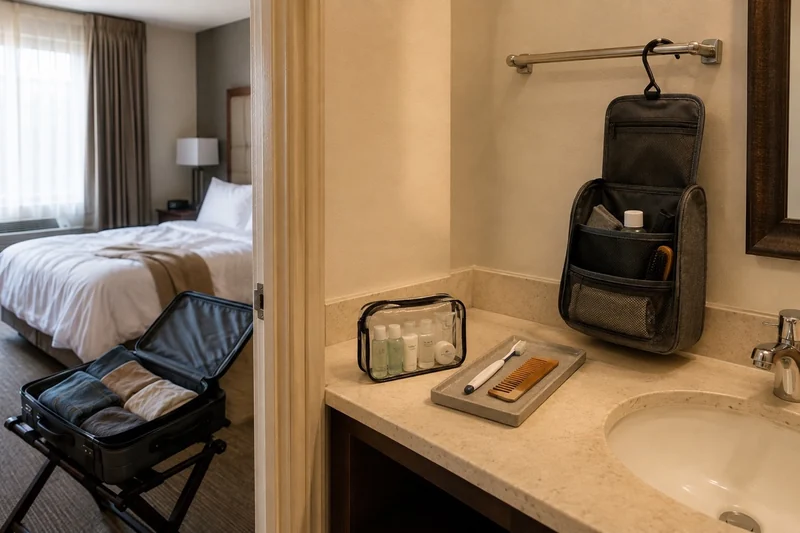
Do not unpack the entire routine onto the hotel sink. Keep three zones: sealed liquids, dry grooming, and daily-use items. Leave backups and occasional items closed in the suitcase. The goal is not a perfect display; it is a bathroom that still works.
Make three zones in two minutes
1. Sealed liquids
Keep bottles in a closed secondary pouch until needed. Place it away from electronics, documents, and the edge of the counter. If the trip involves air travel, check the TSA liquids rule and FAA PackSafe guidance alongside the leak-containment steps. Those packing rules are a separate decision from room organization.
2. Dry grooming
Give the toothbrush, comb, razor, and other dry tools one clean, dry location. A washable hotel glass, a clean cloth, or an existing compartment can work. Do not place dry tools where the faucet splashes or a wet bottle can drain onto them.
3. Daily access
Only the items used every morning and night earn counter space. Put backups, specialty products, and rarely used tools back in the suitcase. This creates a visible reset point: when the daily items return to their zone, the sink is usable again.
Run the no-buy room check
Before buying another organizer, simulate the room at home:
- mark a small counter area with a towel;
- choose one existing sturdy hook or rail at a realistic height;
- load the exact toiletries for the trip;
- open the bag fully and retrieve the five most-used items;
- check whether the setup blocks the mirror, faucet, towel, door, or electrical outlet;
- close, carry, and repack everything once.
If the routine cannot fit the marked area, edit the routine before enlarging the bag. If the loaded bag swings, twists, or strains the support, use the counter or suitcase instead of improvising.
Do not hang from just anything
A door edge, shower hardware, light fixture, sprinkler, cosmetic mirror, or loose towel fitting is not automatically a safe hanger. Use only a sturdy existing point that is clearly intended to bear ordinary bathroom items. Keep the bag away from heat, water spray, moving doors, and anything it could damage.
The hanging test is simple: the loaded bag should sit still, open without forcing the fixture, and leave the bathroom controls usable. If any part fails, move it.
Use the suitcase as overflow storage
The suitcase is already in the room. Keep refills, medication not needed at the sink, styling tools, and occasional products grouped in one accessible area instead of duplicating them on the counter. A packing cube or spare pouch can be an overflow drawer without becoming another product recommendation.
This also makes checkout easier: daily items return to the three zones, overflow returns to the suitcase, and the room gets one final sweep.
When a hanging toiletry bag may help
A hanging bag can help when the bathroom has almost no counter and a safe support point exists. It can be the wrong answer when the room lacks compatible hardware, the loaded bag projects into the sink, or the routine needs containers too large for its internal geometry.
The hanging-toiletry-bag research shortlist compares compact, flexible, and full-size formats by those constraints. It does not assume that every traveler needs one.
What this setup cannot prove
- A home simulation cannot reproduce every hotel fixture, counter, or housekeeping policy.
- A pouch does not make a bottle leakproof or replace current travel rules.
- Use a fixture with a known load limit that supports the packed bag; choose countertop storage when that limit is unclear.
- Medical and regulated items may need storage conditions that override this routine.
Bottom line
Keep liquids sealed, dry tools separate, and only daily items in reach. Use a safe existing hanging point when it actually improves access; otherwise keep the organizer on the counter or in the suitcase. A smaller visible routine usually solves more of the hotel-sink problem than a larger bag.
For the rest of the packing system, see how to pack clothes with fewer wrinkles and the travel-packing topic hub.