
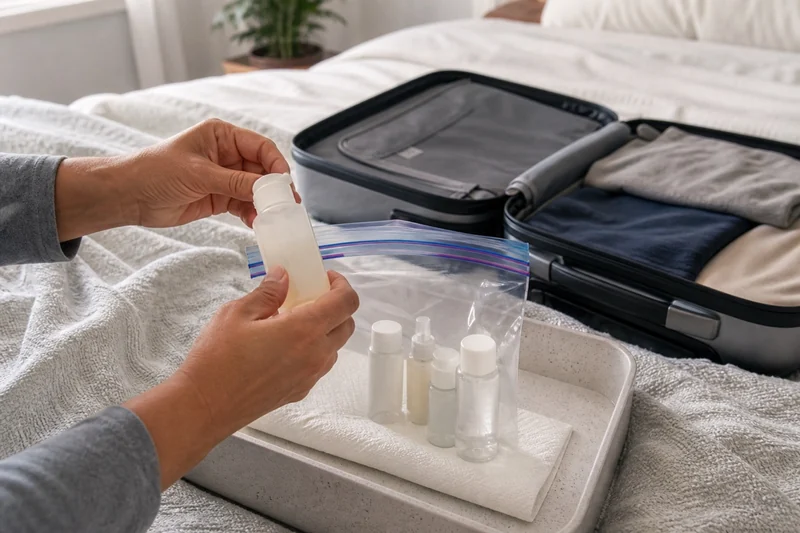
Packing for the checkpoint and packing against leaks are two different jobs. Start by deciding what is allowed in the bag. Then make sure one failed closure cannot reach the rest of your luggage.
Sort the items before choosing containers
Make four groups: carry-on liquids, checked-bag liquids, solids, and anything that needs its own exact rule. The TSA liquids rule limits carry-on liquids, aerosols, gels, creams, and pastes to containers of 3.4 ounces or 100 milliliters or less inside one quart-size resealable bag per passenger. The container size controls—not the amount left inside a larger bottle.
The TSA checkpoint rule is not the only rule. The FAA PackSafe chart covers hazardous-material restrictions and exceptions for items such as toiletry aerosols. An item that is permitted in checked baggage may still have quantity, cap, or packaging requirements. Check the exact product and your airline before travel rather than treating “toiletry” as automatic permission.
Use as you go
Your working checklist
0 complete
The five-minute packing check
Match the container to the product
Thin liquids, thick creams, oils, and products with pumps do not behave the same way. A closure that holds water for ten seconds has not proved it will hold shampoo, oil, or a thick cream for an entire trip. Test with the actual product and clean the outside before it enters the bag.
Do not fill an unmarked bottle with something that could be mistaken for another product. Use a clear, durable label on the container itself, and do not decant a product when its instructions or safety information require the original package.
Independent testing can help identify what deserves a closer look, but “leakproof” still needs a method. Travel + Leisure reports squeezing, dropping, tossing, and shaking 14 bottle sets while checking for leaks and damage. That gives you a useful test method to consider. Try your own bottles with the liquids and fill levels you plan to carry, checking the closures before packing.
Use two defenses, not one hack
The primary bottle should contain the product. The secondary pouch should contain the consequence if the bottle fails. A piece of plastic film under a cap, an elastic band, or squeezing air from a bottle may change one failure mode, but none proves that the cap, threads, hinge, pump, or container body will remain sealed.
For products you can replace at the destination, a solid format or an unopened manufacturer travel size may remove the need to decant. Choose the format that suits your routine and destination requirements.
Pack for access as well as containment
Keep the carry-on liquids pouch where it can be removed without unpacking the entire bag. Keep checked liquids upright when the suitcase design allows it, cushion rigid containers from impacts, and protect aerosol release devices as the FAA requires. Do not pack the pouch where a hard object can continuously press a flip cap or pump.
Before closing the suitcase, photograph or list any personal-care item whose exact identity may matter later. That makes it easier to replace a product without guessing if the label becomes unreadable.
Common questions
Do full-size toiletries belong in checked baggage?
Some ordinary toiletries can travel in checked baggage, but “checked” does not make every size or formula acceptable. FAA hazardous-material limits and airline rules still apply. Search the exact item before packing it.
Does TSA require toiletries to stay in the original bottle?
The TSA carry-on liquids rule focuses on container size and screening. A product's own instructions, medication rules, labeling needs, destination rules, or airline policy may create additional reasons to keep the original package. Do not generalize one rule to every product.
Can any bottle be guaranteed not to leak?
No packing check can guarantee that. A clean closure test and secondary pouch reduce the chance and consequence of a failure; they do not certify a container as leakproof.
Before the zipper closes
Confirm the rule, test the real closure, and isolate the liquids. If a bottle cannot pass a simple home check—or if a leak would ruin something important—replace the container or leave the product out.
That three-step routine keeps the checkpoint bag simple and gives any spill a second barrier before it reaches clothes, documents, or electronics.
After arrival, use the three-zone hotel-bathroom setup to keep the sink usable. If a new organizer still appears necessary, compare hanging toiletry bags by bottle load and hotel setup.
See how to pack clothes with fewer wrinkles for the next packing decision, or compare packing cubes by the problem they solve.