
The short answer
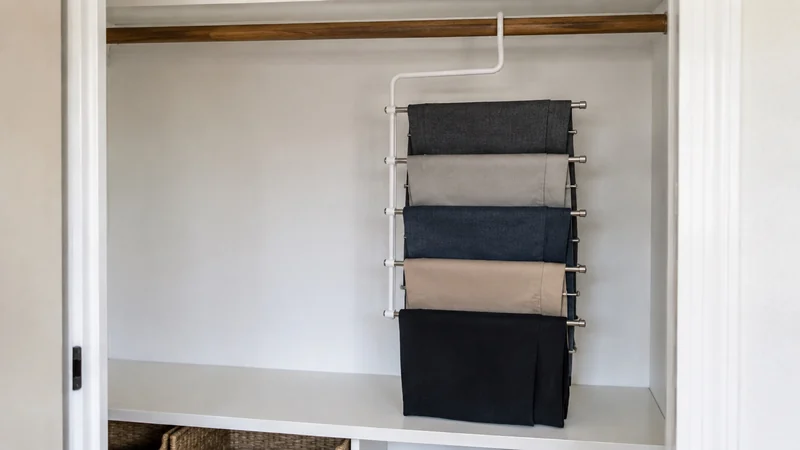
A space-saving pants hanger can reduce the amount of rod width used by several pairs of pants. That is only one part of closet fit. The same hanger may require more vertical clearance, create a thick bundle, hide lower storage, or add extra motions every time a pair is removed and returned.
The useful question is not “How many hangers can fit?” It is “Can the clothes still be seen, reached, removed, and returned without rebuilding the closet?”
Measure the space the loaded hanger will use
Record four constraints before choosing a format:
- Rod width: Measure the section of rod that can be assigned to pants without squeezing daily shirts, dresses, or jackets.
- Rod drop: Measure from the top of the rod to the first shelf, drawer, shoe zone, or other obstruction below.
- Garment bulk: Five thin dress pants do not form the same stack as five jeans. Measure the clothes you actually own while they are folded over existing hangers.
- Retrieval and return: Count how many motions it takes to remove a middle pair and put it back neatly.
A product's empty dimensions do not establish the space it will occupy when loaded. Fabric thickness, folded length, hardware spacing, and the closet's lower zones all change the result.
Match the hanger format to the job
| Closet job | Format to screen | What it may improve | The catch |
|---|---|---|---|
| Free rod width for another clothing category | Five-tier vertical hanger | Moves several folded pairs into one narrow rod position | Needs enough drop below the rod and can make the middle pairs slower to reach |
| Reach one frequently worn pair in one motion | Single open-bar hanger | Keeps each pair visible and independently removable | Uses more rod positions than a vertical stack |
| Hang skirts or trousers from the waistband | Adjustable clip hanger | Avoids folding the garment over a bar | Clip marks, grip, waistband width, and hook fit still need checking |
| Current closet already passes the access test | Keep the hangers already owned | Costs nothing and avoids adding hardware | Does not create a new category of space; the zoning may still need work |
Run a no-buy loaded-stack test
Use five representative pairs of pants from the closet—include the thickest pair, not just the thinnest.
- Fold each pair over an existing hanger as it would hang on a horizontal bar.
- Hold the five loaded hangers together to estimate the bundle's real thickness.
- Mark five descending bar positions with removable tape or string, using the spacing published for the option only as a starting point.
- Check whether the lowest folded garment clears the shelf, shoe zone, drawer, or floor storage below.
- Simulate removing the middle pair and returning it ten times.
- Reject the format if it blocks another useful zone or if the return motion is annoying enough that clothes will likely migrate elsewhere.
This screen can expose an obvious geometry or access mismatch. It cannot prove grip, balance, coating life, clip marks, hardware durability, or long-term ease of use.
What the current evidence adds
Wirecutter reports testing ten pant hangers with multiple fabric weights and identifies the slim MAWA KH1 as the strongest open-bar result in that panel. The same article keeps clip hangers as a separate job and identifies the MAWA K30D for skirts. That separation matters: a compact single bar, a tiered stack, and adjustable clips do not solve the same retrieval problem.
Apartment Therapy documents more than a year of editor use with an exact five-tier Kalimdor hanger and describes switching between a horizontal loading position and a vertical storage position. That supports the format's density role, not a universal claim that it saves usable space in every closet.
The manufacturers establish the current MAWA product geometry and hardware. None of the available sources measures the same garments, closet, rod height, lower storage, and daily return task across all three formats.
Do not trust a percentage without the denominator
“Saves space” may refer to fewer hooks on the rod, a thinner empty hanger, or a seller's staged closet. It does not automatically mean more usable clothing capacity, faster access, or a better-maintained closet.
Reject percentage claims that do not state what was measured, what garments were loaded, and what competing setup was used. A crowded vertical bundle can free several inches of rod while making the rest of the closet harder to use.
Bottom line
Use a tiered pants hanger when rod width is the real bottleneck, vertical clearance is available, and those pants do not need one-motion access. Use separate open-bar hangers for high-frequency pairs. Use clips when hanging from the waistband is the better garment interface.
Start with the broader small-closet access-frequency guide, then compare the current pants-hanger research options by the job each format is designed to solve.