
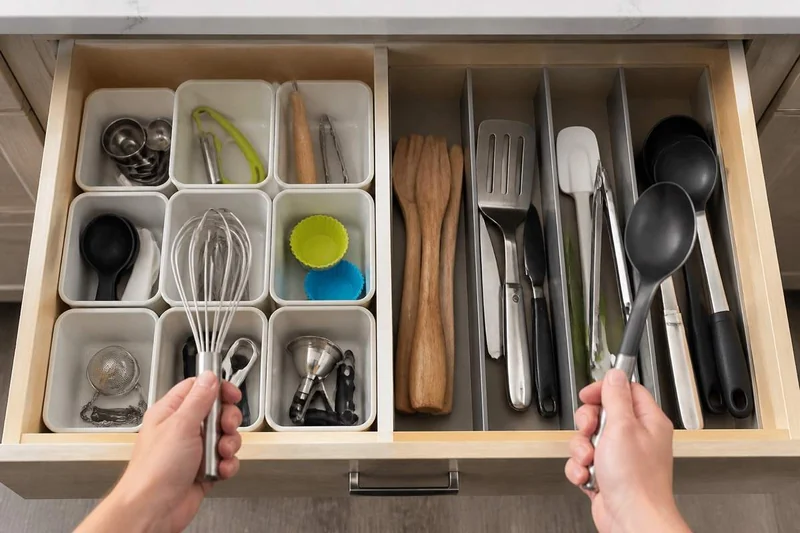
Start with the items that do not fit neatly
Put the longest utensil and the smallest loose tools in the empty drawer first. Tongs need a different space from bag clips. A layout that gives both a usable home matters more than the number of matching pieces in a set.
Lowe’s drawer guide recommends sorting and measuring before selecting organizers. Use that starting point to test the awkward items, rather than buying a set and forcing everything into it.
Leave one long lane instead of filling every inch
Bins make small groups easy to lift out. Dividers can preserve a longer lane without imposing a fixed compartment length. You can combine one small bin for clips with a divided lane for tongs and turners; the whole drawer does not need the same system.
A useful check is whether you can lift out the item you use most without moving its neighbors. If a deep bin makes you dig, or the utensil has to sit diagonally across several zones, change that compartment before choosing the rest.
Count usable space inside the walls
Consider this hypothetical layout: a drawer has 15 inches of usable width. Two bins with 7-inch outside widths use 14 inches and leave a 1-inch strip. If their inside widths are 6.5 inches, they provide 13 inches of storage width inside the bins. The rest is walls and the leftover strip—not extra compartment space.
That does not make the bins a bad purchase. It tells you to check whether their lift-out convenience is worth the space in this drawer. A divider also uses space and needs a compatible span and grip.
Test the two awkward items before the whole set
Use the proposed organizer’s outside dimensions to mark its footprint on paper. Mark the actual inside compartments if those dimensions are available. Place the longest utensil and smallest loose items in their planned zones, then check the loaded drawer’s closing clearance.
If height is tight, use the organizer fit guide before choosing a stacked or angled layout. A paper plan reveals geometry; it will not establish whether a divider grips or a loaded bin slides.
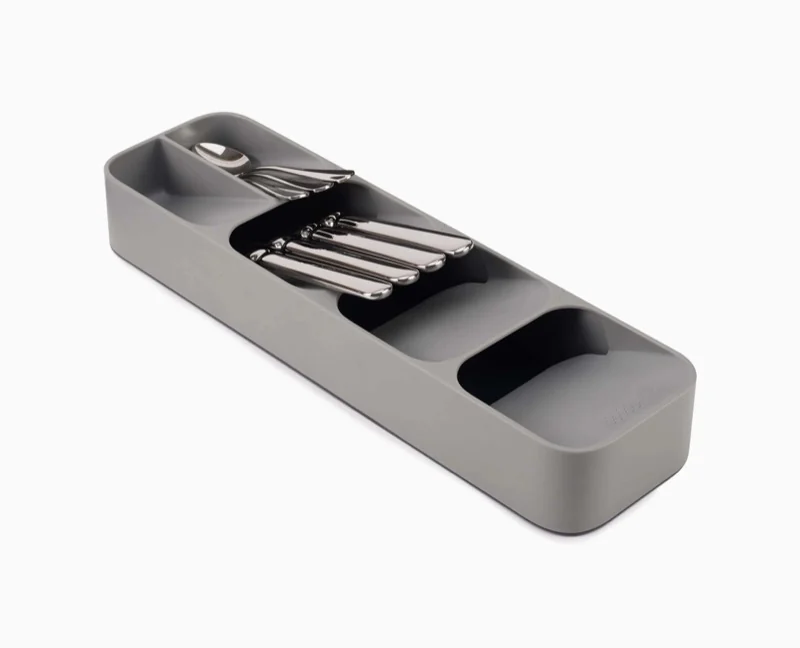
The Joseph Joseph DrawerStore Compact Cutlery Organizer is a fixed, angled cutlery option to check when horizontal room is limited and closed-drawer height allows it. For larger utensils or mixed layouts, compare the existing organizer options.