
Start with the material, not the machine
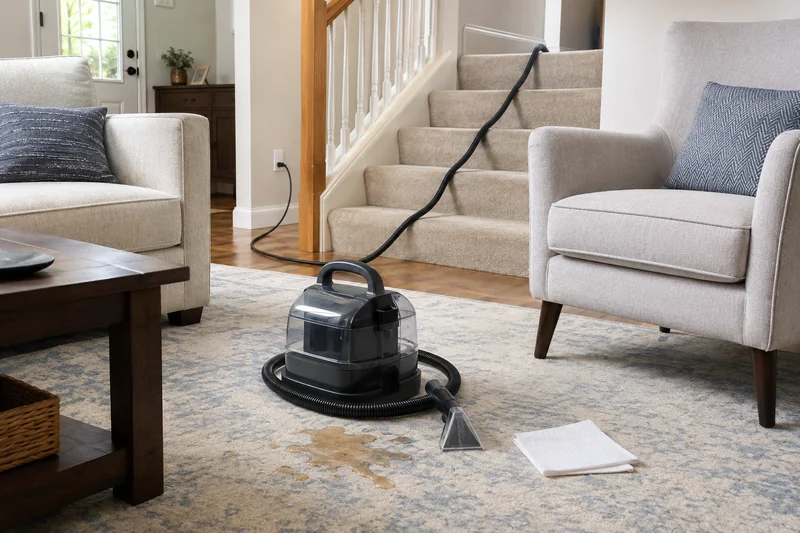
A portable carpet cleaner is a small extractor for localized carpet, upholstery, stair, or vehicle jobs. It is not automatically safe for every fiber, backing, cushion, dye, or care code, and it is not a whole-room carpet machine.
Check the carpet, furniture, or vehicle manual before applying water, solution, heat, or steam. Pretest the approved method in a hidden area. If the material is unknown, delicate, unstable, or explicitly excludes wet extraction, stop and use its professional-care route.
Separate floor washing from fabric spots
A hose tool is useful when you need to reach upholstery, stairs or a small carpet patch. For recurring kitchen-floor messes, a rolling floor washer may match the routine better. Use the floor-washer versus carpet-cleaner comparison to choose the job before comparing tank sizes.
Define the repeated mess
Write down what actually happens: one drink spill on a rug, pet accidents in several rooms, food on upholstery, muddy vehicle fabric, or a larger recurring patch. The repeated mess determines useful capacity and tools better than a long accessory list.
The Carpet and Rug Institute recommends blotting rather than scrubbing, testing cleaning solutions, and working from the edge of a spot inward. Treat that as a low-risk first response while following the exact material and product directions.
Map the full cleaning route
Measure from a safe outlet to the farthest spot. Add the cord and hose lengths, but subtract the bends and body position needed to keep the machine stable. For stairs, decide where the cleaner can sit level without blocking the walking path or pulling against the hose.
| Route question | What it changes |
|---|---|
| How far is the stain from an outlet? | Cord reach and safe body placement |
| Is the work on stairs or in a car? | Carry weight, hose reach, and tool size |
| How large is one typical patch? | Tank capacity and cleaning-path width |
| How many spots repeat per session? | Refill, emptying, and rinse trips |
| Where will parts dry? | Storage time and odor control |
| Can the area stay unused until dry? | Extraction passes, airflow, and scheduling |
Choose the smallest lane that clears the job
Compact all-around spot cleaner
This lane fits small carpet spots, upholstery, and vehicle work. A smaller body is easier to carry and store, but the tank and hose may require more movement on larger jobs.
High-capacity or wider-path cleaner
A larger clean-water tank and wider tool can reduce refills and passes across a bigger repeated patch. That can make a larger job more convenient. Balance fewer refills against the filled weight and storage space.
Steam and multi-mode cleaner
Steam can be a specialized tool for compatible sticky or oily messes. It adds heat, modes, weight, and material restrictions. Use it only when the exact care guidance and machine instructions support the method.
Rent or keep the current method
For whole rooms, a full-size extractor or professional service is the more appropriate format. For one rare small spill, immediate blotting and an approved manual treatment may avoid another appliance entirely.
Plan extraction and drying
Cleaning is not finished when the visible mark fades. Use slow extraction passes as directed to recover as much moisture as possible, then provide safe airflow and keep traffic off the area until it is fully dry. Over-wetting can leave residue, extend drying, and allow a deeper stain to move back toward the surface.
After the job, empty and rinse the tanks, clear the nozzle and hose as the manual directs, and let washable parts dry before storage. A machine stored wet can turn a solved spill into an odor problem.
When an upright earns its space
A larger portable tank can help with repeated patches; it does not change the hand-tool working position. For room-sized carpet, compare the floor-cleaning format as well as refills. An upright with a supported hose may cover floor and upholstery work, but the body still needs a stable place to sit. The portable-versus-upright guide shows what a larger format adds and what the specifications cannot establish.
Choose for the job you repeat
Choose by material compatibility, repeated mess, patch size, cord-and-hose route, filled carry weight, refills, and drying. Compact, high-capacity, and steam-capable models solve different jobs; none replaces a whole-room extractor.
When the job is defined, compare the three portable-cleaner lanes. If an existing cleaner leaves too much water or a stain returns, use the suction and drying diagnostic before replacing it.