
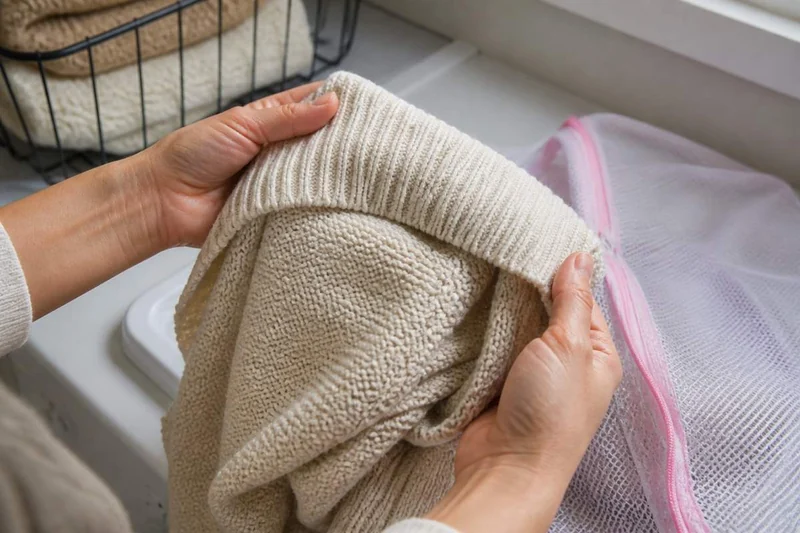
Pilling is shaped by rubbing, fabric construction, daily wear, and laundry care. You cannot redesign the fabric, but you can reduce avoidable friction and learn which care choices help the garment look better for longer.
Start with the label, not a hack
Read the garment label before changing the water temperature, cycle, or drying method. A generic “cold and gentle” tip is not permission to ignore the item’s actual care instructions.
Then look at where the pills form. Concentrated patches under an arm, below a bag strap, at a seat belt, or between the thighs point to repeated wear contact. More even change across the outer surface may make laundry abrasion worth inspecting. These are clues, not laboratory proof.
Run a one-change friction audit
Use as you go
Your working checklist
0 complete
Changing everything at once may feel thorough, but it hides which step mattered. The goal is not to “prove” a universal cure; it is to remove avoidable rubbing without damaging the garment another way.
Do not copy every laundry tip
Some advice conflicts by fiber and product. Woolmark tells readers to avoid fabric softener on wool, while broad Whirlpool and Maytag guidance says to consider softener and discusses cellulase detergents. That is exactly why Digital Derek does not turn those suggestions into one rule for every garment.
Follow the garment label and any care-product directions. If the fabric is special, structured, coated, or uncertain, ask the garment maker or a qualified cleaner before experimenting.
What prevention cannot fix
Care changes cannot redesign the yarn or fabric. Technical clothing-longevity research notes that fiber length, yarn twist, finish, fabric weight and density, wearer behavior, and test method can all affect pilling. A pill-prone garment can therefore continue to pill even after careful washing.
If visible material is already present, first check whether it is truly attached pilling or loose lint, fuzz, or hair using the pilling vs. lint guide. Prevention and removal are different jobs.
Bottom line
Start with one care-label-safe change you can observe. If it helps, keep it; if it does not, restore the old routine and test the next likely source of friction. That simple loop protects the garment and gives you a routine based on what actually works for it.