
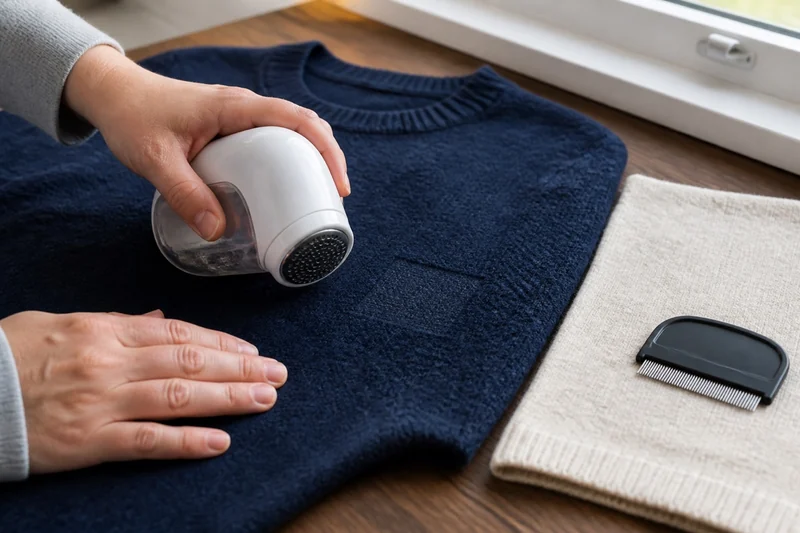
Different tests produce different winners
Two current hands-on roundups do not agree on the best fabric shaver. Good Housekeeping selects Conair overall after testing more than 18 electric and manual tools. Shop TODAY selects Magictec overall after testing seven devices and places Conair in a thinner-clothing role.
That split is not a tie to average away. The publishers used different garments, exposure rules, product pools, and evaluation designs. The useful decision starts with fabric risk and control, not vote count.
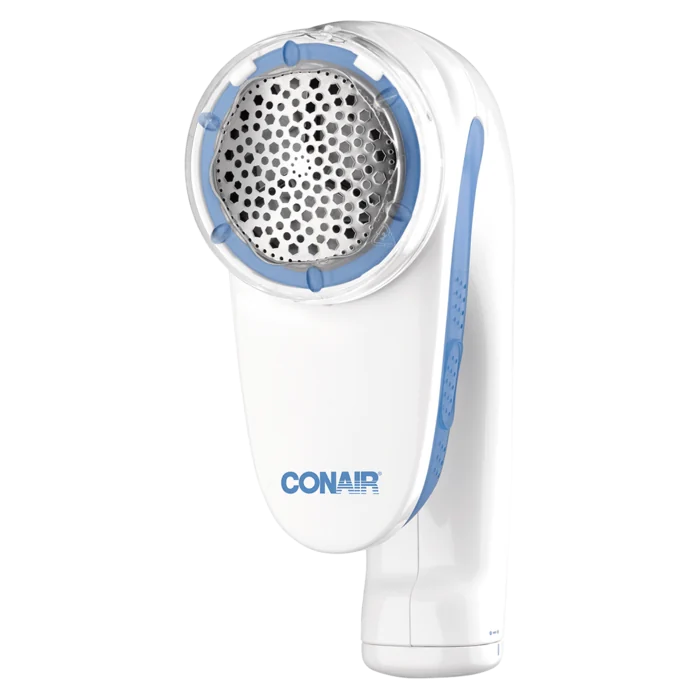
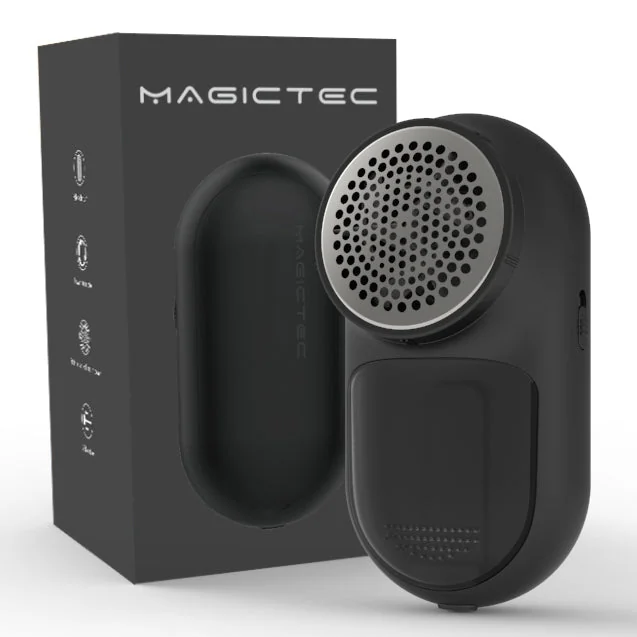
Product identity sources: Conair's current manufacturer page and Magictec's manufacturer page. The photos identify the products discussed; use the live listing to confirm the current offer.
Start with the fabric, not the device
| Situation | Lowest-risk next move | What a powered shaver must prove | Stop or choose another tool when |
|---|---|---|---|
| Loose hair or lint | Use a lint roller or appropriate brush | Nothing; cutting is the wrong job | Material lifts without cutting |
| Raised pills on a sturdy, flat knit | Consider a guarded shaver after the care label and manual | Controlled removal without snags, thinning, or surface change | Loose threads, embroidery, seams, or unstable knit are in the test zone |
| Light surface pills on a controlled knit | Consider a manual sweater comb with gentle passes | Predictable control and acceptable effort | The comb catches, distorts, or pulls fibers |
| Delicate, fuzzy, loosely knit, embellished, or high-stakes garment | Follow the care label and seek specialist guidance | A broad consumer roundup cannot establish safety | The manual excludes the material or a hidden test changes the surface |
If you are not sure whether the material is attached pills, loose lint, raised fuzz, or hair, start by comparing pilling vs. lint. A faster cutter does not improve a wrong diagnosis.
If you have confirmed the surface problem but are still choosing between lifting and cutting, use the fabric shaver versus lint roller guide before comparing exact shaver models. That format decision can keep a powered tool off a garment that only needs loose debris removed.
What the stronger tests contribute
Good Housekeeping reports testing more than 18 electric and manual tools. Its controlled setup used identical rayon-polyester cardigan sweaters washed and dried 15 times to create heavy pilling, then considered one-pass removal, total passes, ease, comfort, cleaning, runtime, and consumer feedback. That is useful controlled evidence, but the page does not publish a per-model raw dataset, standardized pressure, or a quantified later-damage result.
Shop TODAY reports testing seven devices on taped areas of cotton-denim pants, a cotton shirt, and a polyester-blend sweater for about 30 seconds per spot. It considered setup, features, efficiency, volume, and cleaning. That offers a useful look across several fabrics. Treat the results as short-session observations; the published method leaves pressure, starting pill density and later wear unspecified.
Both sources performed real tests. Neither method can be treated as the universal answer for every fiber, knit, garment value, or user technique.
What each method rewards
Good Housekeeping's controlled repeat-pilling garment emphasizes comparable removal performance. Shop TODAY's multi-garment closet test emphasizes behavior across naturally different fabrics. One gives a stronger common starting point; the other gives broader real-garment variety. Both include usability and cleanup, but neither publishes enough raw evidence to reproduce the final ranking.
That helps explain the headline disagreement:
- Good Housekeeping: Conair is its overall selection.
- Shop TODAY: Magictec is its overall selection; Conair is assigned to thinner clothing.
These are attributed publisher findings. A product appearing in both pages is useful corroboration, but the different test methods still explain why the final roles differ.
Keep the fabric looking good after the first pass
A useful result leaves the fabric smoother without lifted threads or thinning. Read the garment label and exact tool manual, lay the fabric flat and dry, and start on a hidden area with the most protective permitted setting. Use light pressure and stop if the surface changes. Check it again after ordinary wear or washing, when the care label permits.
The current product shortlist
The Conair CLS1X is the controlled-test research lead because Good Housekeeping used the stronger common starting condition. The Magictec bergw-175 is the multi-garment challenger because Shop TODAY exposed it to a wider garment mix. Choose the method that better matches the garment you care about.
The exact identities were checked on August 31, 2026. Seller, price, stock, shipping, returns, and warranty remain volatile marketplace facts and are not claimed here. BEAUTURAL remains outside the verified shortlist because its current exact seller identity is unresolved; Philips is not excluded merely for price, but it still lacks a useful role in the reviewed evidence that would improve this two-product test.
Neither linked option becomes safe for a particular garment until the exact manual, care label, hidden-area check, and fixed-area test all pass.
Frequently asked questions
Is Conair the consensus winner?
No. Good Housekeeping names it overall, while Shop TODAY assigns its overall label to Magictec and places Conair in a thinner-clothing role. Their methods and product pools differ.
Does a fabric shaver remove lint too?
A cutting head is designed for raised attached material. Loose lint or hair may call for a roller or brush instead. Diagnose the surface before choosing the tool.
What is the most important safety check?
Read the garment care label and exact product manual, then begin on a flat, dry, low-stakes hidden area using the safest permitted setting. Stop if the tool catches, lifts threads, or changes the surface.
The best result is a smoother surface with the garment unchanged. Start small, use light pressure, and keep the tool only if it earns a place in your care routine.