
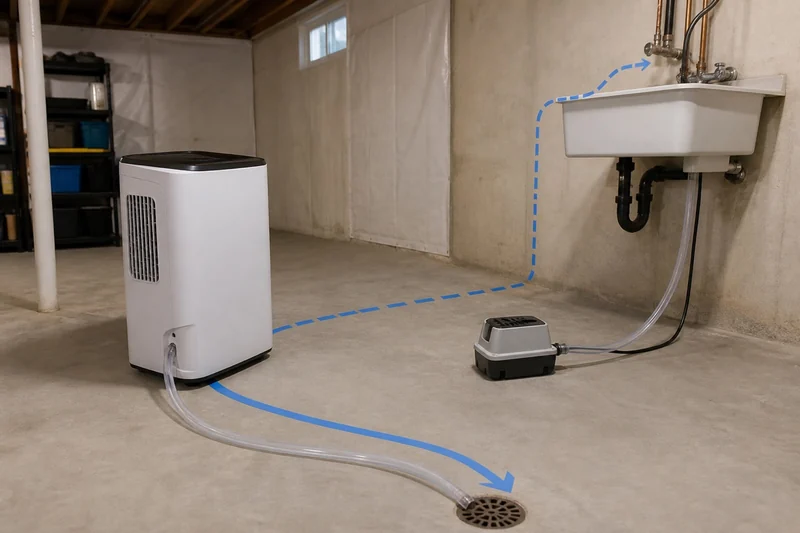
The drain elevation decides the first branch
For a dehumidifier pump vs gravity drain decision, start with one physical fact: is the approved water destination lower than the dehumidifier's drain outlet for the entire route?
- If yes, a gravity hose is usually the simplest continuous option.
- If no, gravity cannot push water uphill. You need manual bucket emptying, a built-in pump, or a separate condensate pump.
The words “continuous drain” do not automatically mean “pump.” Many units can drain continuously only when the hose runs downhill.
Why is my dehumidifier not draining through the hose?
Check these three things before buying a pump or replacing the unit.
| What you see | Check first | What to do next |
|---|---|---|
| Gravity hose attached, but water still collects in the bucket | The correct drain port, a fully seated connection and a downhill route | Remove uphill loops or kinks and follow your model's hose-installation steps. A lower final drain does not fix a raised section along the way. |
| Pump hose connected, but the pump has not started | Pump mode and the model's starting water level | Check the manual before treating water in the bucket as a fault. Some pumps wait for a fill threshold. |
| Pump warning, blocked hose or leaking connection | The manual's cleaning and connection checks | Turn off and unplug the unit before servicing accessible parts. If the error remains, use the manufacturer's service route. |
Midea’s drainage guidance shows the separate gravity and pump connections.
Water left in the bucket can be normal
The Midea MAD50PE1QWT-B manual says its pump starts at the level-four fill threshold and leaves some water behind to keep the inlet submerged. That is expected behavior for this model, not a universal setting.
If your gravity route genuinely needs to rise, compare the four drainage plans below. If the route already works downhill, correcting the connection or hose may solve the problem without buying another machine.
Compare all four water-handling plans
| Water plan | Best fit | What it avoids | The catch |
|---|---|---|---|
| Manual bucket | No approved drain and a safe, manageable carry route | Hose installation and pump components | Repeated lifting; full-bucket shutoff interrupts operation; bucket capacity is not daily removal capacity |
| Gravity hose | A safe lower drain with a continuous downhill route | Pump motor, reservoir, sensor, and elevated discharge | No uphill sections; slope, kinks, fittings, crossings, and destination must work continuously |
| Separate condensate pump | Water must rise and a serviceable modular setup is acceptable | Replacing an otherwise working dehumidifier when only the pump fails | Adds another reservoir, power cord, float/sensor, hose, alarm decision, cleaning task, and leak point |
| Built-in pump | Water must rise and compact integration matters most | A separate pump enclosure and some external plumbing | Pump access and repair may be limited; exact lift and hose limits vary; current test panels report conflicting long-use experience |
This is a routing comparison, not a product ranking.
Run the dry route test before buying
Use painter's tape or a spare hose to trace the full route without moving water.
- Mark the proposed dehumidifier footprint and the exact drain-outlet height.
- Mark the final approved discharge point.
- Trace every horizontal and vertical segment, including doors, walls, furniture, stairs, walkways, and exterior exposure.
- For gravity, verify a continuous downward path. A dip followed by a rise can hold water even when the final destination is lower.
- For a pump, measure required vertical lift and total route length, then compare both with the exact manual. Do not use a generic “up to” number.
- Identify every fitting, reservoir, float, check valve, power connection, and point where a leak could go unnoticed.
- Decide what happens after a power outage, hose disconnection, clogged line, full reservoir, failed sensor, or failed pump.
If the route crosses a walkway, depends on a door staying open, can freeze, or ends at an unapproved discharge point, redesign it before choosing a machine.
Why the test panels disagree about built-in pumps
Good Housekeeping selects a built-in-pump Honeywell for its overall basement convenience lane. That method values the ability to send water vertically or horizontally without a separate pump box.
HouseFresh, after months of home use, reports that internal pumps failed in two tested units. Dehumidifier Buyers Guide also expects early built-in-pump failures and prefers a standard dehumidifier plus a separate condensate pump when elevation is unavoidable.
Those reports do not prove every internal pump fails. They do establish that the pump should be evaluated as a serviceable failure point, not treated as a free convenience feature.
When gravity drainage is the better fit
Gravity is a strong starting point when:
- an approved floor drain or other lower destination is nearby;
- the hose can remain continuously downhill;
- the route stays visible enough to inspect;
- fittings and hose size match the exact manual;
- the hose will not kink, freeze, clog, or create a trip hazard;
- a leak at the unit or drain will be noticed and contained.
Gravity is not maintenance-free. Inspect the hose, connection, slope, drain, and surrounding floor. Clean them according to the exact manual.
When a separate condensate pump is the better fit
A separate pump can be useful when water must rise and you want the pump to remain replaceable independently from the dehumidifier.
The separation creates its own job. The dehumidifier still needs a safe downhill route into the pump reservoir. The pump needs compatible capacity, lift, tubing, power, placement, cleaning, overflow response, and discharge. Some installations may benefit from an alarm or secondary containment, but the exact plan depends on the equipment and space.
Do not improvise with an open bucket and an unrelated pump. Use equipment and connections intended for condensate handling, follow both manuals, and verify the discharge destination.
When a built-in pump is the better fit
A built-in pump may be the more compact choice when:
- the water must move upward;
- the exact model's documented lift and route fit the space;
- its pump hose and fittings are included or clearly specified;
- the warranty, return window, and service route are acceptable;
- the owner has a plan for a pump failure or alarm;
- gravity and a separate-pump installation are not practical.
Verify whether the unit can fall back to bucket or gravity operation if its pump fails. A similar model name without a pump—or a successor with a new suffix—may have different drain ports, hose, controls, and failure behavior.
Choose the setup you can inspect and service
Before calling any setup “hands-off,” answer these questions:
- Where does water go if power fails?
- Does the dehumidifier stop when the pump reservoir is full?
- Is there a visible or audible error, and will anyone notice it?
- Can the pump, hose, reservoir, and fittings be reached for cleaning?
- Can the pump be replaced without replacing the dehumidifier?
- Is there containment under every connection where a leak would damage the room?
- What does the exact warranty cover, and who provides service?
A good continuous setup keeps the water path visible, cleanable, and easy to restore after an interruption.
Check the exact manual—not a generic feature list
For the exact dehumidifier and any separate pump, verify:
- gravity-outlet and pump-outlet locations;
- hose diameter, thread, material, and maximum length;
- vertical lift and routing limits;
- whether loops, check valves, or traps are allowed;
- reservoir, float, shutoff, alarm, and restart behavior;
- cleaning and seasonal-storage instructions;
- minimum operating temperature and freeze precautions;
- grounded outlet and extension-cord restrictions;
- approved discharge destinations and local requirements.
Retailer bullets and category roundups cannot replace those exact instructions.
Common drainage questions
Can a dehumidifier drain into a sink without a pump?
Only if the exact drain outlet and entire hose route remain above the sink discharge point and the exact manual allows that arrangement. A sink above the unit normally requires a pump.
Is a drain hose the same as a pump hose?
No. A gravity hose carries water downhill without pressure. A pump hose is part of an active system and may use different diameter, fittings, lift limits, and routing rules. Follow the exact manual.
Is an external condensate pump more reliable?
The qualified panel does not provide a universal failure rate. A separate pump is more modular and may be replaceable without replacing the dehumidifier, but it also adds components and maintenance. Compare the exact products and failure plan.
Does continuous drainage mean I can stop checking the unit?
No. Hoses can kink, clog, disconnect, freeze, or leak; pumps and sensors can fail; drains can back up. Inspect the route and follow maintenance instructions.
Finish sizing before comparing products
If capacity is still unclear, use the basement dehumidifier sizing worksheet. Once both the sizing and water-route checks pass, compare basement dehumidifiers by drainage plan. You will reach that comparison with the most important choice already made: where the water can go every day with the least complicated service plan.