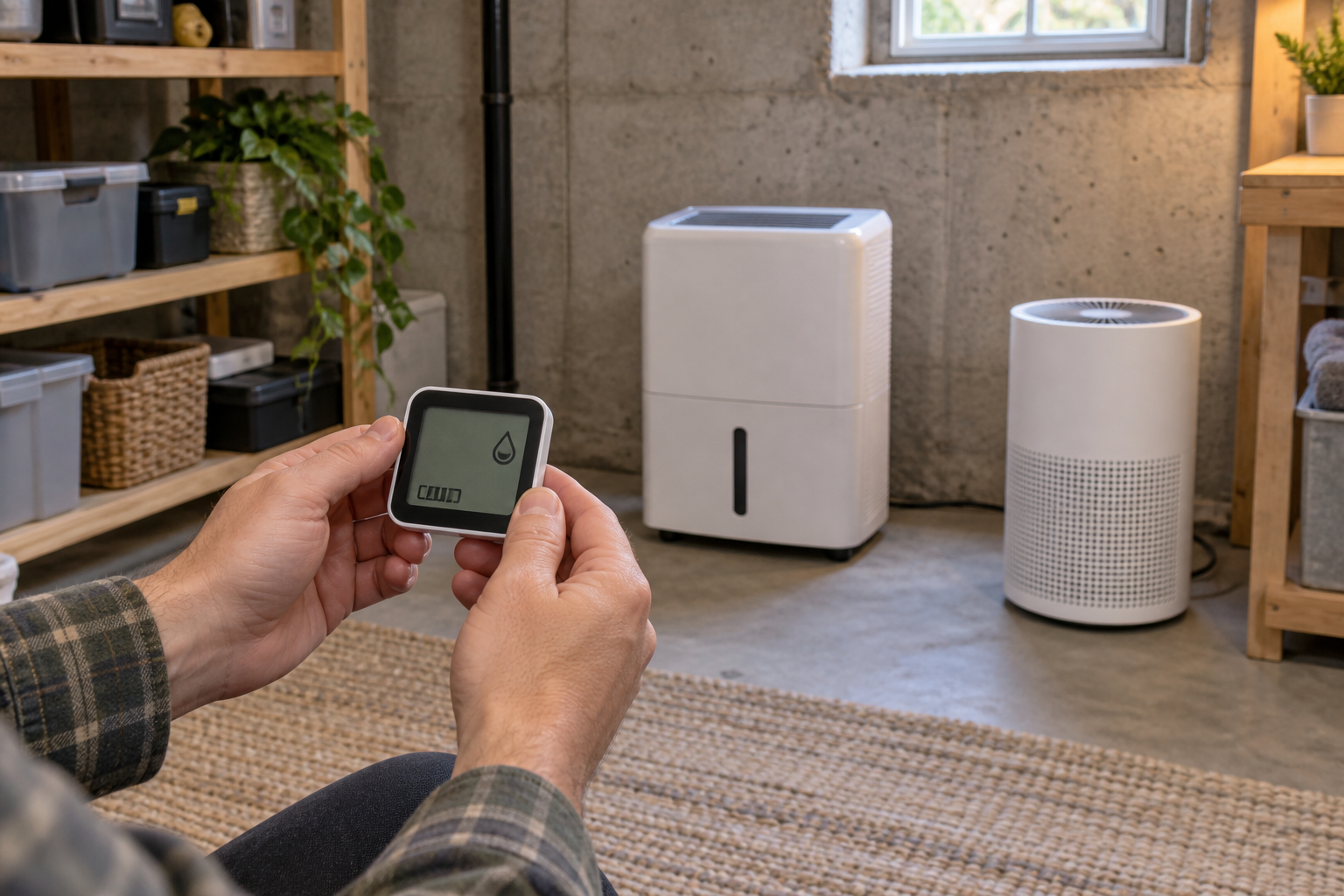
Compare the jobs, then the numbers
The most useful spec depends on what you want the appliance to do. A large coverage claim alone does not settle either purchase.
| Buying question | Dehumidifier | Air purifier |
|---|---|---|
| What does it remove? | Water vapor, collected in a tank or drain | Airborne particles through filtration |
| Which capacity number matters? | Pints per day, with the stated test conditions | Clean air delivery rate (CADR), matched to room area |
| What goes into the setup? | Space, room temperature and a practical water route | Space, open airflow and access to replacement filters |
| What goes into the ongoing cost? | Electricity and water-handling upkeep | Electricity and replacement filters |
ENERGY STAR explains dehumidifier capacity and air-cleaner sizing. CADR and pints per day measure different jobs; they are not competing performance scores.
For damp air, choose the water route first
A humidity reading is more useful than a musty smell alone. EPA recommends keeping relative humidity below 60% where possible, ideally 30–50%. Repeated high readings help identify a moisture-control job.
A lower drain can make a gravity hose convenient. If water must travel upward, compare a pump setup; if there is no hose route, choose a bucket you can empty comfortably.
Compare basement dehumidifiers by drainage, including the AEOCKY Rhea-003 gravity-drain research pick. Use the capacity guide to narrow the size and the running-cost calculator to budget for use.
Size an air purifier for the room you use
For a basement office or sitting area with airborne dust or pollen, match the purifier to that room. These ENERGY STAR starting values assume an 8-foot ceiling; taller rooms may need a higher CADR.
| Room area | Minimum CADR to compare |
|---|---|
| 100 sq. ft. | 65 cfm |
| 200 sq. ft. | 130 cfm |
| 300 sq. ft. | 195 cfm |
| 400 sq. ft. | 260 cfm |
| 500 sq. ft. | 325 cfm |
| 600 sq. ft. | 390 cfm |
Example: a 20 × 20-foot room is 400 square feet, so start by comparing at least 260 cfm. Check filter availability and sound at the setting you intend to use. EPA notes that lower fan speeds filter less air.
Browse ENERGY STAR-certified air cleaners with that size in mind. This is a model-discovery route; Digital Derek has not selected an exact purifier for this comparison.
Will either one remove a musty smell?
An air cleaner cannot resolve the moisture source of mold or a musty odor. It may help with some airborne particles or odors, but wet materials and mold need their own response. Use EPA's cleanup guidance when that is the job.
If moisture is controlled and particle filtration is still useful, both appliances can have a role. You do not need to buy both simply because the room is a basement.