
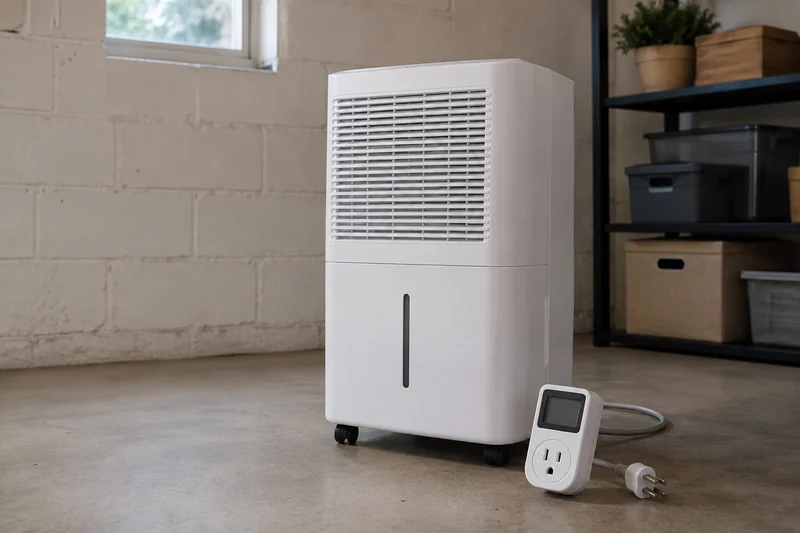
Start with the electricity the machine actually uses
A dehumidifier can stay plugged in all day while its compressor cycles. Calculating 24 hours at its rated wattage assumes a pattern that may not match your basement. A measured kWh total over a representative period gives you a better starting point for your own estimate.
Use an energy monitor suitable for the appliance's load and consistent with both manufacturers' instructions. Record elapsed time, total kWh, the humidity setting and whether the room was unusually wet. Include normal off cycles. Do not treat an initial dry-out day as a settled monthly average.
Calculate your estimate
Your running cost
Estimate electricity cost from your own readings
Use measured energy across a representative period and the rate from your bill. No model consumption or tariff is assumed.
Formula: measured kWh ÷ measured hours × 24 × days × rate ÷ 100. Use a representative period; humidity and compressor cycling can change consumption. Electricity only; fixed utility charges, purchase and maintenance costs are excluded. Inputs stay in this browser. Energy-cost calculation method.
The calculator uses your measured average across the whole observation period. It does not assume that the compressor runs continuously. Use the per-kWh charges that apply to additional consumption on your bill; fixed monthly charges do not increase because you run this appliance. For a time-varying tariff, calculate each rate period separately and add the results.
The underlying relationship is energy multiplied by its unit price, as explained by Virginia Cooperative Extension's appliance energy guide. The examples below use invented inputs solely to show that arithmetic. They are not measurements of any shortlisted product or a typical utility rate.
| Illustrative use over 24 hours | Rate | Daily electricity cost | 30 identical days |
|---|---|---|---|
| 2 kWh | 20¢/kWh | $0.40 | $12 |
| 4 kWh | 20¢/kWh | $0.80 | $24 |
| 8 kWh | 20¢/kWh | $1.60 | $48 |
What changes the result: doubling energy use doubles cost at the same rate. A different rate changes the bill without changing the appliance. Keep those two inputs separate when comparing estimates from other households.
Compare efficiency and capacity as different questions
ENERGY STAR defines integrated energy factor, or IEF, in liters per kWh. It includes energy consumed in dehumidification and specified standby or off modes. A higher value indicates more water removed per unit of electricity under the test conditions; it is not a daily operating-cost figure.
Capacity answers a different question: how much water the unit removes per day under its stated test. ENERGY STAR explains that the portable-dehumidifier test moved from 80°F to 65°F, producing lower capacity numbers for otherwise comparable machines. Compare ratings on the same basis before concluding that a newer machine is smaller or less capable.
Do not divide a model's advertised pints by an unrelated efficiency figure to forecast your bill. Both numbers need matching conditions, and your room's moisture load still determines how the unit operates. The basement dehumidifier comparison shows which exact-model figures are supported and where the comparison remains incomplete.
Work out what an upgrade would have to save
Use this as a threshold worksheet before paying extra for efficiency:
| Input | What to use |
|---|---|
| Extra upfront cost | The actual difference between the two complete purchase options |
| Current electricity cost | A representative measured estimate for the season you use it |
| Expected saving | Supported comparable evidence; leave this blank if you do not have it |
| Simple payback | Extra upfront cost divided by annual electricity saving |
For example, a hypothetical $100 premium and a supported $25 annual saving would give a four-year simple payback. That arithmetic excludes repairs, financing, tariff changes and product lifespan. If the saving is unknown, the payback is unknown too. A larger percentage on an advertisement does not fill that blank.
If the bill feels high, check the room as well
Keep the measurement useful by recording whether doors and windows were open, the drain was working and the humidity setting stayed the same. ENERGY STAR's buying guidance discusses placement, closed windows and doors, and reduced performance in colder conditions. A machine working against continuing moisture entry has a different job from one maintaining an already dry room.
If the room never reaches the desired humidity, use the sizing guide before assuming that lower wattage is the answer. If a full bucket repeatedly stops operation, compare the pump and gravity-drain options. Choose the machine and drainage arrangement that can maintain the room, then compare its electricity use over a representative period.
Use the formula for the appliance doing the job
The watts × hours × electricity-rate calculation can also estimate another appliance’s energy use, but use that appliance’s own power and operating pattern. If heat rather than dampness is the problem, window versus portable AC helps choose a workable cooling installation. Do not reuse a dehumidifier’s wattage or duty cycle for an air conditioner.