
Choose where the water goes before choosing the machine
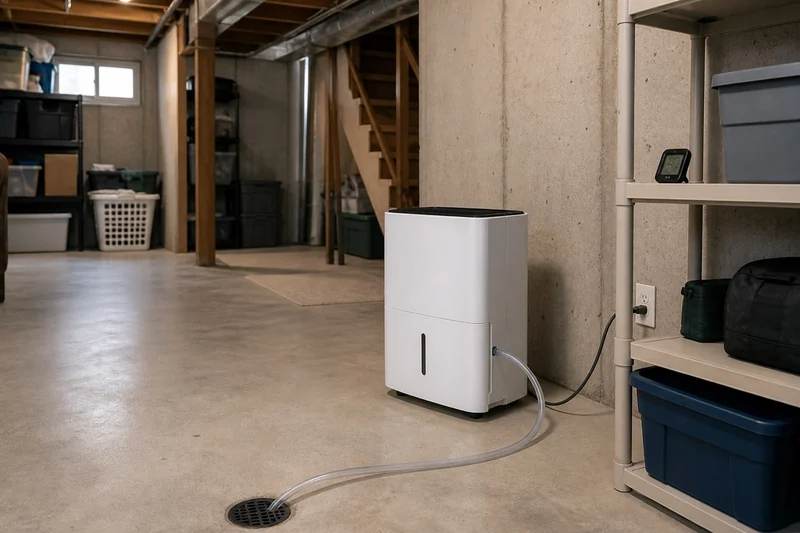
The search for the best basement dehumidifier often starts with pints per day, square feet, brand, or price. Start one step earlier: is there active liquid water that needs repair, and where can the condensate drain every day?
A portable dehumidifier can manage airborne moisture. It is not the repair for flooding, seepage, a plumbing leak, failed exterior drainage, sewage, wet materials, or a mold-remediation need. EPA says moisture-source control is the key, with indoor relative humidity below 60% when possible and ideally 30–50%.
Still deciding which appliance you need? Compare an air purifier with a dehumidifier to separate particle filtration from moisture removal.
Find the drainage route that fits
Once the moisture source is addressed, a workable drain plan makes the machine easier to live with:
| Your basement setup | Useful next step | What makes the route work |
|---|---|---|
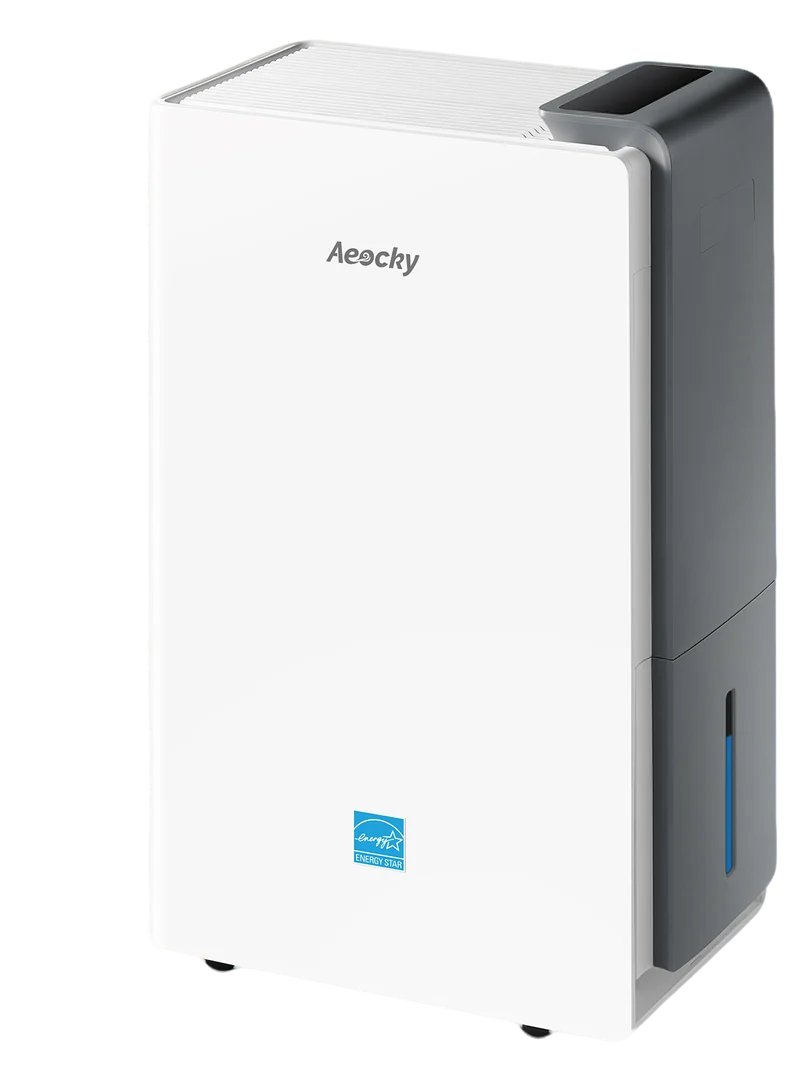
| An approved drain below the unit | Review the AEOCKY Rhea-003 gravity-drain option | Check capacity, operating temperature and a continuous downhill hose path |
| Water must travel upward | Compare pump and gravity drainage | Match the pump’s lift limit and service plan; the gravity-drain pick below is not a pump recommendation |
| No practical hose route | Compare bucket handling before capacity | Choose a bucket you can empty safely at a manageable frequency |
| An unheated room | Compare desiccant and compressor units | Match the actual room temperature; minimum operating temperature does not promise full capacity |
Only the exact Rhea-003 has an active product link in this article. The Midea and Frigidaire sections explain which model changes still need resolving, so their older test results are kept separate.
AEOCKY Rhea-003 for a gravity-drain setup
HouseFresh purchased the exact AEOCKY Rhea-003 (ASIN B0FWB57KYQ ), used a repeated high-humidity test, weighed extracted water, measured power and noise, and then used models in real rooms over time. It places the Rhea-003 in the large-basement or whole-house portable option.
That supports a current research role, not a universal winner. The page reports a smaller bucket than the Midea Cube and recommends a gravity hose in a very humid space. The exact Rhea line also includes 001, 002, and 003 variants, so capacity, tank, dimensions, and noise cannot flow between them.
Current seller, featured offer, price, stock, shipping, returns, warranty execution, and long-term reliability remain offer-specific or unknown.
Midea Cube: useful family consensus, replacement-model caution
Dehumidifier Buyers Guide selects the tested Midea Cube MAD50S1QWT in its 50-pint panel. HouseFresh uses a 35-pint Cube in its own basement and values the raised bucket and gravity-drain geometry. Good Housekeeping also places a 50-pint Cube in its versatile option.
The Cube design earns attention across these sources. Match the model number when comparing their findings. The current publisher destination points to MAD50S1QWT-A, while the strongest direct test names MAD50S1QWT. The HouseFresh unit is 35 pints. Until the replacement is independently tested or its equivalence is documented, the current `-A` model stays a research option rather than inheriting the predecessor's results.
Frigidaire: a clear example of why exact model continuity matters
Dehumidifier Buyers Guide places FHDD5034W1 second in its current test panel. Frigidaire's official support record now marks that exact model discontinued. The publisher's current product link redirects to FHDD5034Y1, a different suffix and Amazon identity.
The newer destination may be a reasonable product, but that has not been proven by the cited `W1` test. It should not receive the old model's speed, efficiency, noise, or ranking simply because the brand and capacity look similar. This replacement remains held from the shortlist until exact evidence catches up.
Why current best-dehumidifier lists disagree
| Source | What its method emphasizes | Current lead | Why the result does not transfer automatically |
|---|---|---|---|
| Dehumidifier Buyers Guide | Humidity-reduction speed, power, noise, hygrometer accuracy, build, and usability across more than 50 units | Midea Cube `MAD50S1QWT` | Its current retailer destination uses a new `-A` suffix; it also broadly favors 50-pint units |
| HouseFresh | Repeated high-humidity runs, weighed water, power, noise, and months of home use | AEOCKY Rhea-003 | It rewards a high-capacity gravity-drain job and reports two internal-pump failures |
| Good Housekeeping | 48-hour controlled removal, noise, usability, home use, cleaning, and customer service | Honeywell 50-pint with built-in pump | Its pump-first overall role conflicts with two panels' reliability warning |
| RTINGS | Airflow, capacity, temperature stability, noise, heat, and tested water removal | Frigidaire `FFAP5034W1` | Its article contradicts itself about whether that exact Frigidaire has a pump, so that feature claim remains blocked |
The useful consensus is a decision sequence: find the moisture source, measure temperature and RH, plan drainage, then compare capacity, noise, heat, energy, bucket handling, and serviceability.
Run a source-and-drainage check first
- Inspect for active liquid water, plumbing leaks, seepage, blocked drains, gutter or grading problems, sump issues, and wet materials. Address the source problem rather than asking the appliance to hide it.
- Measure temperature and relative humidity in at least two locations over several representative days. Do not size from one moment or a musty smell.
- Mark the proposed unit footprint, manufacturer clearances, grounded outlet, and drain route.
- For gravity drainage, trace a continuous downhill hose path to an approved lower drain. Rule out kinks, door crossings, trip hazards, and hidden leaks.
- For bucket use, fill a container with the published bucket volume and carry it safely to the sink. If that is not workable, the operating plan fails.
- Check the exact model against the CPSC recall hub and its current manual.
Confirm your water source and drainage route before choosing a unit.
What capacity labels really mean
ENERGY STAR explains that current portable-dehumidifier capacity is tested at 65°F rather than the older 80°F condition. A current 50-pint label therefore cannot be compared directly with an older 50- or 70-pint headline.
ENERGY STAR's current guidance also uses both room size and dampness. A smaller moderately damp room and a large wet basement are not the same load. Square-foot claims alone ignore temperature, ceiling height, air exchange, liquid-water sources, HVAC, placement, and actual runtime.
Pump or gravity hose?
A gravity hose is mechanically simple but only works when water can travel downhill. A built-in pump can move water upward, yet HouseFresh reports failures in two pump-equipped test units and Dehumidifier Buyers Guide recommends a separate condensate pump when elevation is required. Good Housekeeping, by contrast, selects a built-in-pump Honeywell for the convenience option.
The disagreement is useful. Compare the failure and service plan, not just the presence of a pump icon.
Cold basements, noise, heat, and maintenance
Low-temperature operation
Cooler air holds less water, and frost or defrost cycles can change useful performance. Verify the exact model's minimum operating temperature and defrost behavior; do not extrapolate a warm-room test.
Noise and heat
Compressor units make sound and exhaust warmer air. A strong unfinished- basement option may be a poor fit beside a TV room, office, or bedroom.
Filters, coils, buckets, and hoses
Useful ownership includes cleaning access, filter reminders, bucket shape, hose fittings, drain slope, restart behavior, and a realistic service path. These details can matter more than app control.
Recalls and exact identity
CPSC has recalled large groups of dehumidifiers sold under multiple brand names. Check the exact model—not only the brand—before buying used or returning an older unit to service.
Common basement-dehumidifier questions
What size dehumidifier should I use in a basement?
Use both the space and the untreated moisture condition. ENERGY STAR's current chart starts at 20–30 pints for a slightly-to-moderately damp space below 2,000 square feet and rises to 50+ pints for a wet space above 2,000 square feet. Temperature, air exchange, drainage, and active water sources can change the real job.
Is a dehumidifier with a pump better?
Only when water must travel upward and the added pump's failure and service plan are acceptable. A gravity hose is simpler when an approved lower drain is available; a separate serviceable condensate pump is another option.
What basement humidity should I target?
EPA says indoor relative humidity should stay below 60% when possible and ideally between 30% and 50%. Use a separate meter and address the moisture source rather than treating the appliance display as a complete diagnosis.
Turn efficiency into a cost question
IEF compares water removal per unit of energy under specified tests; your bill depends on the energy used in your room and the rate you pay. The running-cost guide explains representative measurements, shows transparent cost scenarios and gives an upgrade-payback worksheet. Leave the savings input blank when comparable evidence is missing.