
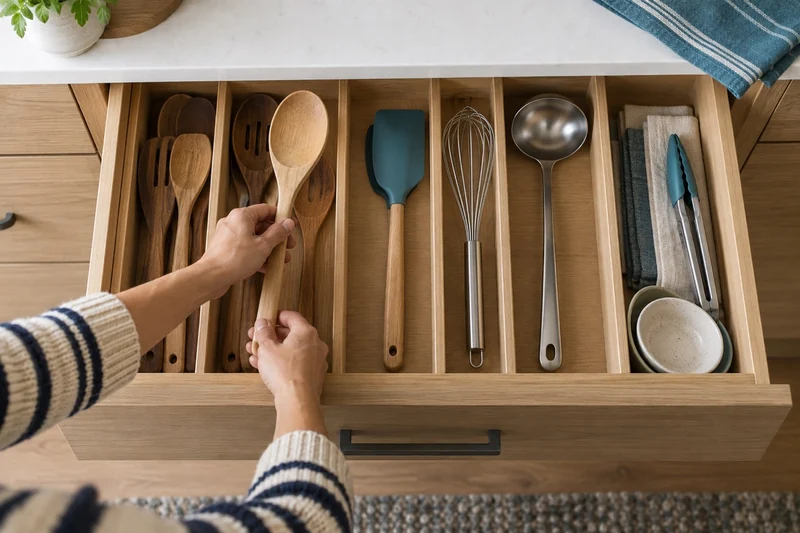
First decide what belongs in this drawer
Do not begin by assigning a compartment to every utensil. Begin with the drawer's job. Is it for everyday cooking tools, food-preparation tools, baking tools, or flatware? A drawer expected to hold all four jobs may remain crowded even after adding organizers.
Lowe's current kitchen-drawer guide starts with decluttering and grouping, then recommends placing frequently used tools near the prep, cooking, or cleanup zone where they are used. Choose the tools you use for each job first, then size the container around your own everyday set.
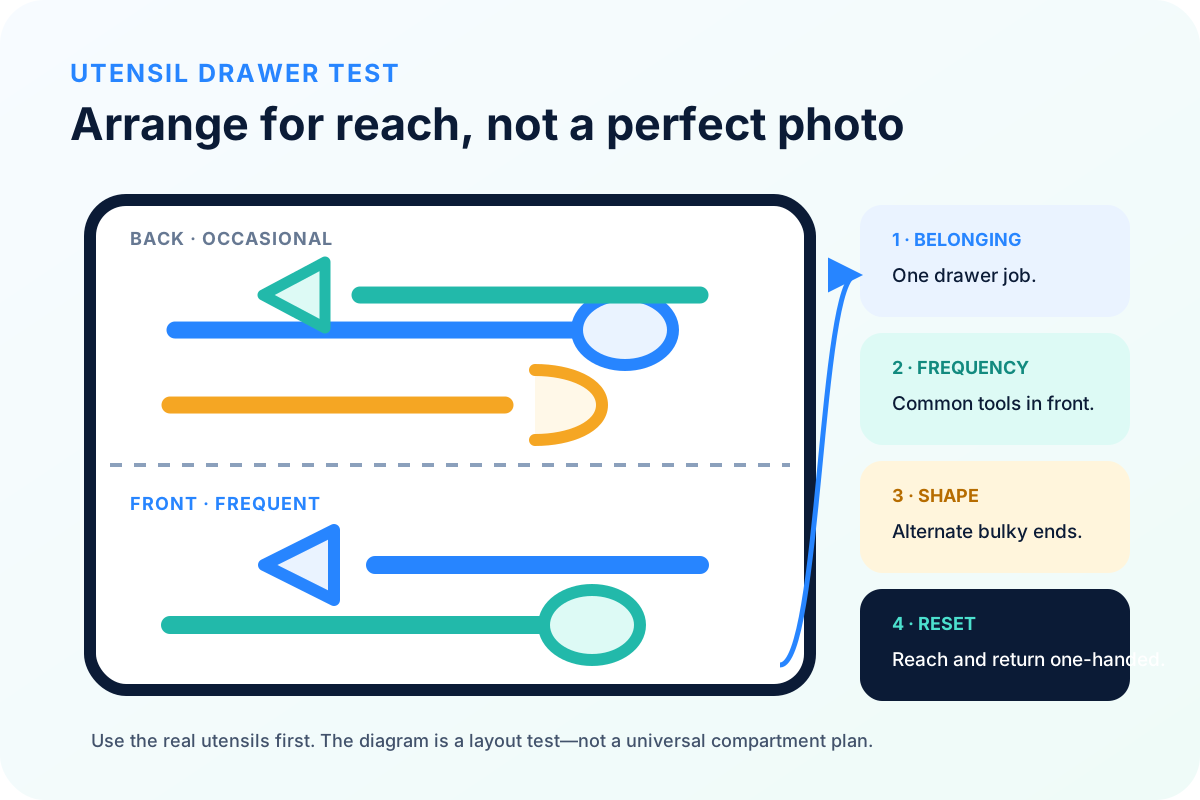
Use a four-pass utensil layout
1. Group by task
Make small working groups instead of one broad utensil pile:
- Turn and stir: spatulas, spoons, and tongs.
- Prep: peelers, graters, measuring tools, and kitchen scissors.
- Serve: ladles, serving spoons, and specialty servers.
- Bake: whisks, brushes, scrapers, and other baking tools.
IKEA's current organization guide also recommends grouping by task and keeping everyday items close to the work zone. Its examples are product-led, so they do not prove that a particular insert fits.
2. Separate frequent from occasional use
Place the tools used most often where they can be seen and reached without lifting another group. Occasional tools can sit behind a frequent group, move to a second nearby drawer, or use another storage location if the drawer is over capacity.
This is a practical arrangement to test, not a promise that one frequency rule works for every cook. Useful duplicates may be justified when several tools are used in the same cooking session.
3. Arrange by length and bulky end
Lay the real utensils in the empty drawer before adding walls. Put similar lengths together, then look at the wide end of each whisk, spatula, masher, or tong. Alternating directions can reduce one crowded edge when the drawer shape allows it. A few long tools may fit diagonally, but only if they stay below the closing path and do not pin smaller tools underneath.
4. Test reach and reset
Reach for each frequent tool as if you were cooking, then return it with one hand. A layout fails when common tools disappear under longer pieces, several items must move before one can be removed, or the only way to reset the drawer is perfect placement.
Try the no-buy version first
Use painter's tape, folded paper, or clean boxes already on hand to mark the proposed groups. The seven-number drawer measurement guide shows how to record the smallest usable width and depth plus the closed-drawer height.
Use as you go
Your working checklist
0 complete
This paper test cannot reproduce tray-wall thickness, sliding, grip, or cleanability. It can reveal that the proposed category pattern is already too large for the drawer.
Choose a container only after the pattern works
Fixed trays are options when the groups and utensil lengths stay stable. Adjustable dividers are options when widths change or long tools need wider zones. Small bins are options when one complete group needs to lift out. The bins-versus-dividers comparison explains those tradeoffs so you can choose for your setup.
Once the layout works, compare drawer-organizer options by usable dimensions, utensil length and cleaning needs. The shortlist explains which formats suit each job.
A counter holder is another option for frequently used cooking tools, but it uses worktop space and exposes the contents. A second drawer can reduce crowding when one is available. The useful choice depends on the actual drawer, utensil shapes, cooking habits, and acceptable countertop use.
Check the layout after seven normal days
Do not judge the drawer only when it has just been arranged. After seven normal days, note which tools migrated, became buried, blocked closing, or never returned to their zone. Change one failed group at a time. The broader kitchen-drawer workflow explains how purpose, placement, fit, and reset connect across the whole kitchen.
What you still need to check
- There is no universal utensil count or layout; keep what supports the way you cook.
- Alternating directions may help some utensils, but handle shapes and drawer dimensions can erase that advantage.
- Test the real utensils in the measured drawer before choosing a tray, divider, bin, or crock. This guide does not recommend a specific organizer.