
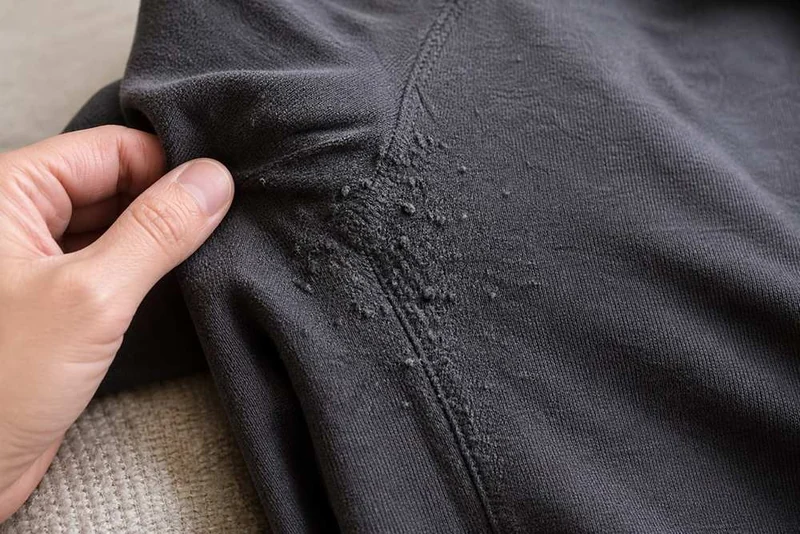
Clothes pill when loose surface fibers rub together, tangle, and remain attached as small balls. Check wear, laundry, and fabric construction to understand where the friction comes from. Use the location and care history to decide what to change first.
1. Wear friction leaves a location pattern
Woolmark points to elbows, armpits, sleeves, the belly, and the sides of a sweater as common high-contact zones. Other repeated contact can come from a bag strap, seat belt, chair, layered garment, or the fabric rubbing against itself.
If the patch lines up with one of those contact points, start by reducing that friction. Assess construction quality separately from the location of the pills.
2. Laundry can add abrasion
Washing and tumble drying move fabrics against the drum, hardware, and other items. Existing loose fibers can work toward the surface and tangle. That can speed up pilling, but a washing machine is not the only possible cause.
Look for what changed:
Start with one question
What is attached to the fabric?
- Did the pills appear mainly at real-life contact points or across most of the garment?
- Was the item washed with rough, heavy, or zippered pieces?
- Did the care label permit the cycle, temperature, and drying method used?
- Is this a loose, brushed, or knitted surface with many exposed fibers?
- Does the visible material stay attached, or is it loose lint, fuzz, or hair?
The last question matters. Use the pilling vs. lint guide before choosing any removal tool.
3. Construction changes the baseline
Fiber names do not tell the whole story. Clothing-longevity research identifies yarn length and twist, lubrication and finish, fabric weight and density, wear, and testing method as contributors. Two garments carrying the same broad fiber label can therefore behave differently.
This also means pilling does not automatically prove “cheap fabric,” and careful laundry does not guarantee a pill-free surface. A visual check cannot reveal every manufacturing variable.
What to do with the clue
If the pattern points to repeated contact, reduce that contact where practical. If laundry is a plausible contributor, follow the care label and change one low-risk variable at a time with the pilling-prevention audit. If the material or care requirement is uncertain, ask the garment maker or a qualified cleaner.
Bottom line
Pilling usually comes from an interaction between surface fibers, repeated friction, and construction. Map the location and check the care history first. That gives you a useful clue, a low-risk change to try, and a better chance of keeping the rest of the garment looking good.