
A laundry hamper has two jobs: hold laundry while parked and move it to the washer. The best storage shape can be the worst transport shape, so treat the route as part of the product.
Start with one line on paper
Write the route as a sequence: closet, bedroom door, hallway, stairs, exterior door, sidewalk, car, laundromat. Cross out every step that does not apply. The remaining transitions are the test course.
For each transition, record whether the hamper must roll, turn, lift, squeeze through, wait, or ride in a vehicle. The hardest transition—not the longest easy stretch—should control the format.
Use as you go
Your working checklist
0 complete
The five-minute route check
If the route has stairs
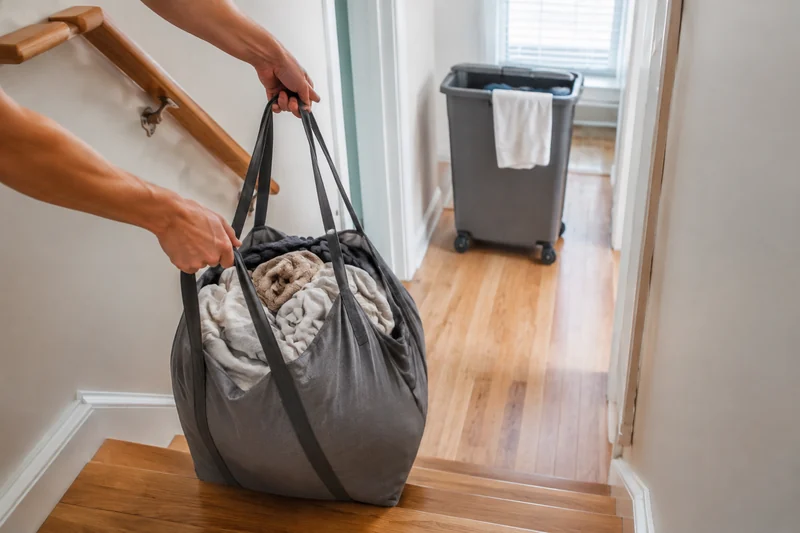
Stairs interrupt rolling. Look for a load you can control, handles that allow a balanced grip, and a body that does not block your view of the steps. The Spruce's hamper tests also identify handle and stair limitations in otherwise useful wheeled designs. A large rigid hamper may roll well upstairs but still require an awkward lift for the most consequential part of the trip.
Do not use this guide as medical lifting advice. If balance, grip, pain, mobility, or stair safety is a concern, reduce the load, make more trips, relocate collection, or use another method suited to the person and home.
If storage is narrow
Measure the exact usable gap, then account for baseboards, door trim, sloped walls, and the space your hand needs to pull the hamper out. A soft narrow format may flex around a small obstruction, but that same flexibility can affect stability when loaded. A rigid format preserves its shape but always occupies its full footprint.
Use removable tape to mark the published footprint. Put a box or current hamper inside the outline and rehearse retrieval before buying.
If the route goes to a laundromat
Extend the map beyond the front door. Include exterior steps, rough pavement, rain exposure, building doors, elevators, the vehicle opening, and the distance from parking to the machines. Small indoor casters are not automatically suitable for sidewalk cracks or long outdoor pulls.
Decide whether one large load or two controlled loads makes the route easier. A liner that lifts from a rolling frame may help at the car, but only if the filled liner has useful handles and remains comfortable to carry.
If damp items are common
Choose ventilation for airflow and a wipeable interior for easier cleaning. Dry damp textiles separately before enclosing them, and follow both the textile and container care instructions. Openings and coatings alone cannot prevent odor or mildew.
Use published dimensions as a starting point
Manufacturer dimensions can help build a floor outline or cardboard stand-in. They do not include every real-world variable: a soft side may bulge, a lid may need opening clearance, a handle may extend, and hands need room around the product.
The current rolling-laundry research panel shows how three different formats map to narrow, same-floor, and stair-heavy routes. It is a format comparison, not a hands-on Digital Derek winner.
What this route check cannot prove
- Caster life, loaded steering, tipping, or performance on a specific floor
- Handle comfort for another person or a heavier load
- Long-term shape, cleaning, ventilation, odor, or material wear
- Fit after a soft hamper bulges or a rigid hamper's handle and lid are in use
Before you buy
Choose the route first, then the format, then the product. If the hardest transition is a stair or car lift, wheels may be secondary. If the whole trip is flat, rolling can reduce carrying. If the hamper must disappear when empty, collapsibility may matter more than either.
For the storage side of the decision, use the small-closet access guide or measure under-bed storage by the exit path.